
Danielle Ferraro, Beauty Editor.
You lean into the bathroom mirror, wand in hand, and by 11 a.m. your lashes look less like a mascara ad and more like spider legs. There’s a drawer somewhere with four half-used tubes of volumizing mascara, each abandoned for the same reasons: clumping, flaking, or a formula that dried out weeks before it should have. The truth is that most volumizing mascara problems have nothing to do with the mascara itself. They come from how it’s applied, stored, and removed. One fact worth knowing before anything else: the biggest reason a tube dries out early isn’t age, it’s air, pumped in every time the wand goes in and out. Fix that habit alone and most formulas perform better for twice as long.
- Air ruins mascara faster than time does: pumping the wand in and out to “load” it pushes air into the tube and dries the formula from the inside out.
- Wand shape matters more than the word “volumizing” on the box: a fat, densely bristled brush builds thickness, but only a tapered or slightly curved one can do it without clumping at the lash base.
- Removal technique determines how your lashes look next week, not just tonight: rubbing and tugging thins lashes over time, while a soak-and-swipe method protects them.
Why Your Mascara Clumps By Lunchtime
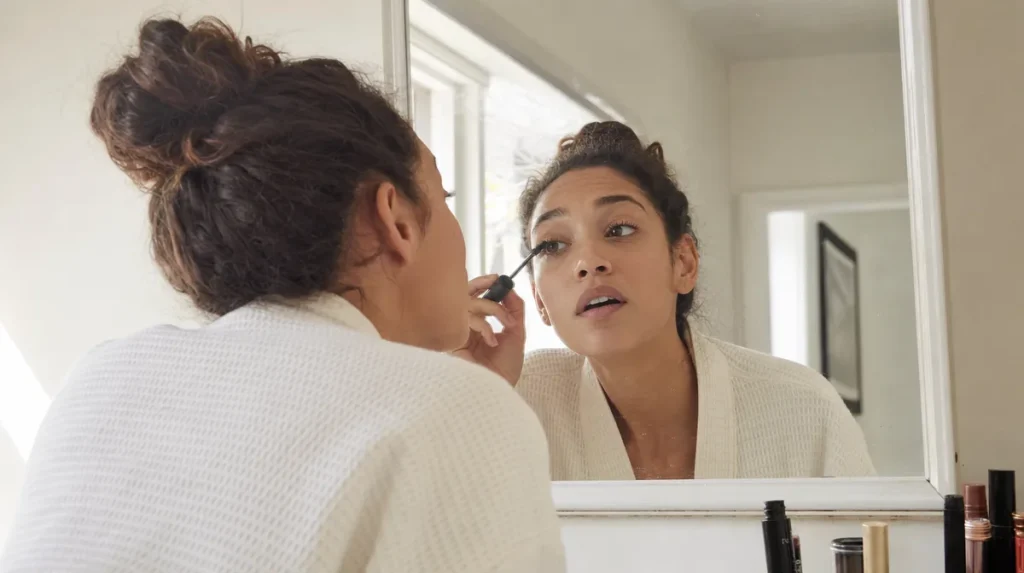
Volumizing formulas work by coating each lash in a layer of waxes and polymers that swell the hair shaft visibly. Think of it the way a coat of paint thickens a fence post: the first coat looks even, but a second heavy coat, applied before the first dries, pools and drips at the joints. Lashes behave the same way. Apply too much product too fast, or apply a second layer before the first sets, and the formula pools at the base and tip, where it dries into clumps.
Most women apply mascara in three or four fast strokes and call it done. The better method is patience: one thin layer, a ten-second pause to let it tack up, then a second layer only where extra thickness is wanted, usually the outer corners. If a formula clumps every single time regardless of technique, that usually points to the brush shape rather than a personal application flaw.
A quick self-test: run a fingertip lightly across dry lashes an hour after application. If it feels waxy and uneven rather than smooth, the layers were applied too close together. Public guidance from the American Academy of Dermatology on eye-area care notes that heavy residue left along the lash line can contribute to irritation for sensitive eyes, which is one more reason thin, patient layers beat one thick swipe.
Reading The Wand Before You Buy
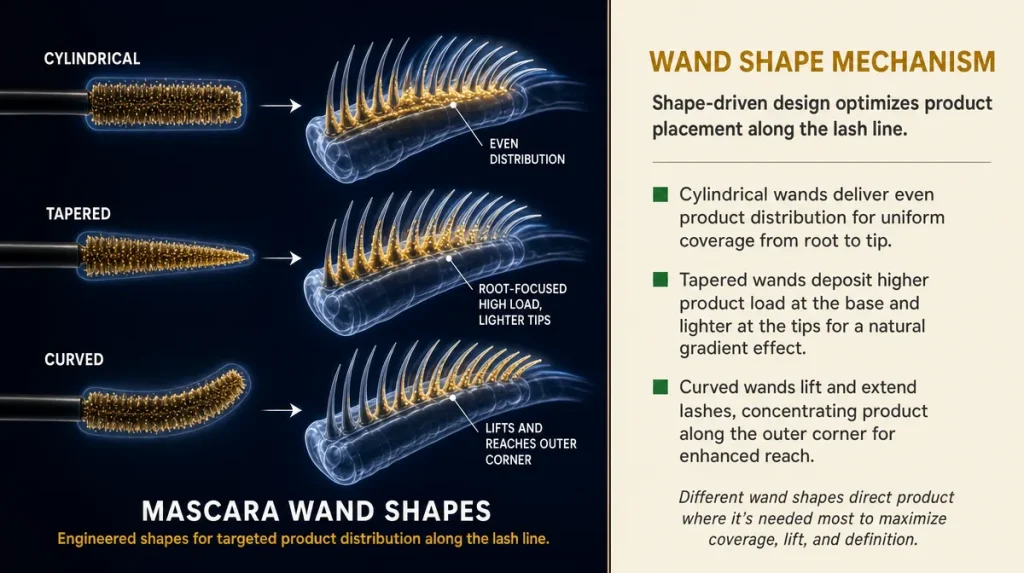
The word “volumizing” on a box describes the marketing goal, not the mechanism. What actually determines whether a mascara builds thickness without clumping is the brush. A tightly packed, fat cylindrical brush deposits the most product per stroke, which is why it promises drama, but it also has the highest clumping risk because it can’t separate lashes as it goes.
A slightly tapered or hourglass-shaped brush, thinner at the tip, thicker in the middle, tends to perform better in practice: the narrow tip reaches inner corner and lower lashes cleanly, while the fuller belly still builds volume on the longer center and outer lashes. A curved wand that mimics the natural lash line helps distribute product evenly along the base rather than dumping it at one angle.
Before buying, it helps to look past the front-of-pack word and check the bristle pattern through the tube, something easy to do while standing in the mascara aisle at a drugstore or at Target. If the bristles look densely clustered with no visible gaps, expect more volume and more clumping risk. If they look slightly spaced, expect a more natural buildup that takes an extra layer to reach the same drama.
The Pumping Habit That Dries Out Every Tube Early
Almost everyone does this: push the wand down into the tube, pull it out, push it back in, two or three times, to “load” more product before applying. It feels productive. It is actually the single fastest way to kill a mascara early.
Every pump pushes a small volume of air into the tube. That air dries the formula at the opening first, which is why so many tubes turn clumpy and dry within six to eight weeks even when plenty of product remains inside. The fix is almost too simple: twist the wand gently while it’s still inside the tube to coat it, then pull it straight out once. No pumping.
A useful comparison is a tube of caulk left with its cap off overnight: the surface skins over and turns unusable long before the rest of the tube does, because air reached it first. Mascara behaves the same way at the opening, just slower.
If a favorite formula, the kind some women call their holy grail, keeps drying out faster than expected, the pumping habit is the first thing to check before blaming the product. This one change alone tends to add real weeks of usable life to a tube, which matters most during a Black Friday or back-to-school drugstore haul when a few tubes are meant to last through a season.
The Order Of Operations: Curl, Prime, Coat
Sequence changes the result more than most people expect. Lashes should be curled before mascara goes on, never after. A curler closing on lashes already coated in product tends to tug, and in worse cases can pull out a few lashes along the way, since the formula makes hair slightly stiff and less forgiving of pressure.
The order that tends to work best: curl first, holding for about ten seconds rather than one quick squeeze, then apply a light coat of primer if one is being used, then the volumizing formula itself in thin layers as described earlier. Skipping the primer isn’t a mistake, plenty of formulas don’t need one, but applying primer after mascara instead of before is, since it undoes the first layer rather than building on it.
One mistake specific to the curling step: curling right at the base only, without also lifting through the mid-lash, creates an unnatural right angle rather than a soft curve. A gentle three-point squeeze, base, middle, tip, produces a rounder lift that mascara can then set in place.
Layering Without Clumping
Building real volume almost always takes more than one layer, but layering is where most clumping happens. The rule that separates a clean buildup from a clumpy mess is timing: each layer needs roughly ten to fifteen seconds to tack up before the next one goes on. Applying layer two while layer one is still wet is what causes the product to pool rather than stack cleanly.
A wiggling motion at the base, rather than a single upward sweep, distributes product more evenly and coats individual lashes rather than gluing several together. Sweeping straight up in one fast stroke looks efficient but tends to bind lashes into small clumps near the tip, especially with thicker volumizing formulas.
A short self-test while applying: after the first layer dries, separate lashes gently with a clean spoolie brush before adding layer two. If several lashes stick together at this stage, that’s an early clump forming, and it’s much easier to fix with a spoolie now than to scrape off dried clumps later. Two well-timed layers, separated between coats, almost always outperform three rushed ones.
Humid Summers, Dry Winters: Adjusting Your Approach
Climate changes how mascara behaves more than most people account for. During humid East Coast summers, formulas soften slightly and are more prone to smudging under the eye by midafternoon, particularly for anyone without a waterproof formula on hand. During dry winters with constant indoor heating, the opposite problem shows up: formulas dry out faster in the tube and can flake off lashes by evening, since the air itself is pulling moisture out of both the product and the skin around the eyes.
A practical adjustment: in summer humidity, a light dusting of translucent powder just below the lower lash line before mascara helps absorb the oil that carries pigment into fine lines. In dry winter months, storing the tube somewhere that isn’t directly on a radiator vent or windowsill, and capping it fully and promptly after each use, slows the drying process that heated indoor air accelerates.
This is also why the same tube can feel perfect in April and disappointing by August: nothing about the formula changed, the air around it did.
Removal Mistakes That Thin Your Lashes Over Time
How mascara comes off matters as much as how it goes on. The most common mistake is rubbing: dragging a cotton pad back and forth across closed eyes to force stubborn volumizing formula loose. This tugs on lashes still anchored in the follicle, and repeated nightly tugging is a real, if gradual, contributor to lash thinning over months.
The better method is a soak-and-swipe: press a remover-soaked pad against closed lashes for ten to fifteen seconds, letting the product dissolve on its own, then swipe downward once, gently, rather than scrubbing side to side. For waterproof formulas, an oil-based remover breaks down the wax content more completely than a water-based one, meaning less friction is needed to finish the job.
The American Academy of Dermatology’s general guidance on eye-area skin notes that this thin skin is more prone to irritation and premature fine lines than skin elsewhere on the face, which is one more reason gentleness at the removal step matters as much as the application itself. Lashes lost to daily tugging don’t grow back overnight; the visible lash line thins gradually, which is often mistaken for the mascara itself “not working” anymore.
When To Replace: The Three-month Rule
Most volumizing mascaras are formulated to stay safe and effective for about three months after opening, regardless of how much product remains in the tube. Bacteria introduced by the wand during daily use, not the cosmetic ingredients themselves, is what eventually makes an old tube worth discarding, particularly for anyone prone to eye irritation.
A simple habit helps: writing the opening date on the tube with a fine-point marker the day it’s first used, since “about three months ago” is notoriously hard to remember by month four. A change in smell, texture, or a formula that suddenly seems to clump no matter the technique is often the tube signaling the end of its usable life rather than a technique problem to troubleshoot further.
Seasonal shopping moments, a fall pumpkin-spice-season restock or a Black Friday drugstore haul, are convenient natural checkpoints for this kind of rotation, since they already prompt a look through the makeup drawer. Replacing on a schedule, rather than waiting for visible failure, avoids most of the clumping and flaking problems this guide has covered.
Key Takeaways
Most volumizing mascara disappointments trace back to a handful of fixable habits rather than a bad formula. Stop pumping the wand to load it: that motion is what dries tubes out early by pushing air inside. Apply in thin, patient layers rather than one heavy pass, letting each layer tack up before adding the next. Curl before applying, never after, and let the wand shape, tapered or curved, guide expectations about volume versus clump risk. Adjust technique with the season: powder under lashes in humid months, careful capping and storage away from heat in dry winter months. Remove with a soak-and-swipe method rather than rubbing, since nightly tugging is a slow but real cause of lash thinning. And treat three months from opening as a real deadline, not a suggestion.
A Quick Checklist For The Mascara Aisle And The Makeup Drawer
- Twist the wand inside the tube instead of pumping it in and out
- Check the bristle shape through the tube before checking the front-of-pack claim
- Apply in two thin layers with a ten-second pause between them, not one heavy pass
- Curl lashes before mascara, holding for about ten seconds at base, middle, and tip
- Add a light dusting of powder under lashes during humid months
- Store the tube away from radiators, vents, and sunny windowsills in winter
- Remove with a soak-and-swipe method, never a scrub
- Write the opening date on the tube and replace it at three months
This article is for general information and does not replace personalized advice from a dermatologist or eye care professional.
Individual results vary depending on skin type, lash type, and application habits.