
Robert Kessler, Senior Health and Science Editor.
You’re standing at the bathroom mirror with the dryer running for the tenth minute, and your hair still puffs out at the crown like it caught a static charge from the dryer itself. The box promised smoother, faster, frizz-free results because of something called ionic technology, and you bought it half on faith. Behind you on the shelf sits a row of half-used creams and serums bought to fight the same frizz, and you start to wonder if the tool in your hand, not the products, has been the real variable all along. Here is the one fact worth knowing before you read further: ionic airflow works by breaking large water droplets into smaller ones on the hair shaft, which is why hair dries faster under it, not because it makes hair shinier on its own. Everything else is a matter of how well a given dryer actually generates that airflow, and how you use it.
- The ion count matters less than the wattage behind it: a dryer can carry a genuine ionic generator and still underperform if its motor cannot push enough hot air through the nozzle.
- A concentrator nozzle does more visible work than any ion sticker on the box: it is the part that actually smooths the cuticle by directing airflow in one direction along the hair shaft.
- Frizz control looks different in a humid July than a dry, heated January: judging a dryer fairly means testing it in both conditions, not just once.
The Five Minutes That Make Or Break Your Morning
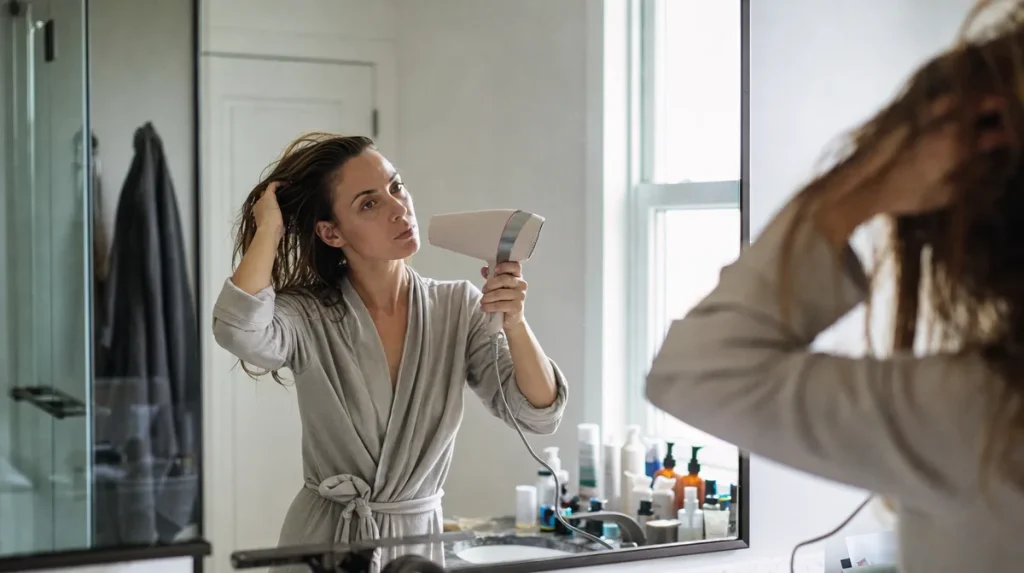
Most of the damage or the smoothness a dryer produces happens in the first few minutes, while hair is still wet enough to be reshaped by heat and airflow. Think of wet hair the way you’d think of pasta just out of the pot: pliable, easy to shape, and easy to overcook if you leave the heat on too long in one spot.
The habit worth building is simple. Section the hair, keep the dryer moving, and work from roots to ends rather than blasting the whole head at once. A dryer with a genuinely strong ionic function will feel like it’s cutting your normal drying time down, often by several minutes, because it is breaking water into smaller droplets that evaporate faster.
If a dryer takes the same amount of time it always has, despite an “ionic” label on the box, that is your first real clue that the label is doing more marketing than mechanical work.
What “Ionic” Actually Does To Water
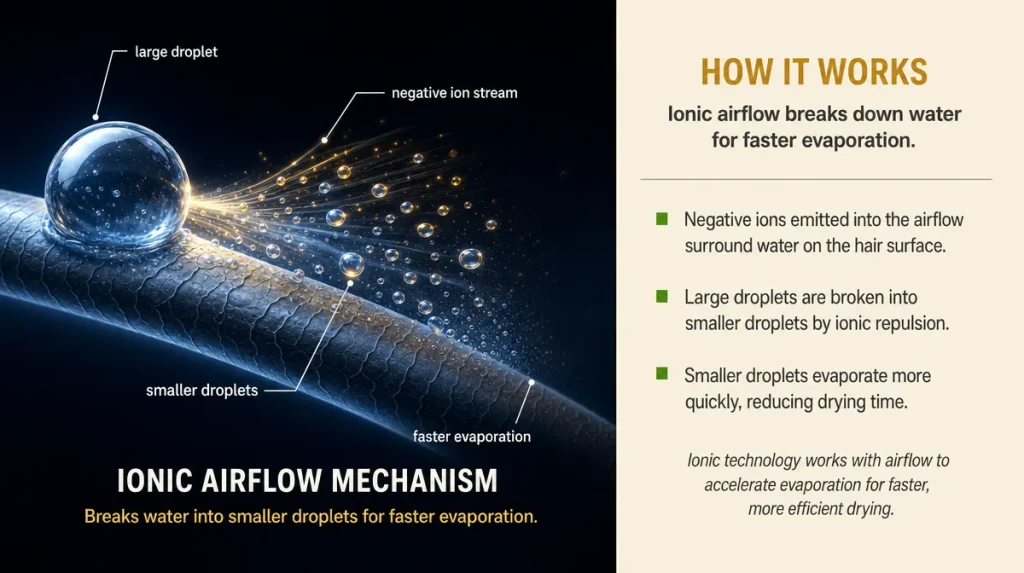
Ionic dryers emit negatively charged particles into the airflow. Water is naturally drawn to positive charges, and the water droplets sitting on wet hair carry a slight positive charge of their own. When the negative ions meet those droplets, they break them into smaller droplets, and smaller droplets evaporate faster.
A useful comparison is fabric softener in the laundry. Softener works by reducing the static cling between fibers so they separate and fall smoothly instead of clumping and frizzing in the dryer. Ionic airflow does something similar to individual strands of hair: it reduces the static charge that makes cuticles lift and catch on each other, which is part of what reads as frizz.
This is a real, measurable mechanism, not an invented one. A study in the Journal of Cosmetic Science examining ionic versus non-ionic drying found visibly reduced frizz and static charge on treated hair samples, though the effect size varied with hair porosity and starting moisture. That variability matters: a dryer’s ionic function tends to help more on fine, porous, or chemically treated hair, which loses moisture and picks up static more easily, than on coarser hair that holds water longer.
Finding The Real Generator, Not Just The Sticker
Almost every dryer sold at a drugstore or a big-box beauty aisle now carries the word “ionic” somewhere on its packaging, because the term sells. Not every one of those dryers houses an actual ion generator, which is a small ceramic or tourmaline component near the air intake that produces the charge.
A rough but honest way to judge this at the shelf: weight and price positioning tend to track with the presence of a real generator, since the part itself and the extra circuitry cost something to include. A dryer priced at the very bottom of a drugstore rack, with “ionic” printed in large letters and no other technical detail on the box, deserves more skepticism than one that also lists wattage, a ceramic or tourmaline coating on the barrel, and a cool-shot button.
If you already own a dryer and want to check, hold a strand of freshly dried hair near the nozzle while it runs. If the strand visibly relaxes and lies flatter within a few seconds rather than lifting toward the airflow, that is a reasonable sign the ionic function is doing real work. This is not laboratory-grade proof, but it is more informative than the box copy.
Wattage And Heat Control Matter More Than The Ion Count
Ionic technology gets the marketing attention, but the motor wattage and the number of heat settings do more to determine whether your hair actually looks good at the end.
A higher-wattage motor, generally in the 1800 to 2000 range for a full-size dryer, moves more air, which dries hair faster and reduces the total time hair spends exposed to heat. Multiple heat and speed settings let you finish on a cooler, faster setting, which the American Academy of Dermatology’s general guidance on hair care notes can help limit cumulative heat exposure to the hair shaft over repeated stylings.
A simple self-test: dry one section of hair on the highest heat setting only, and a similar section using medium heat plus the cool-shot button at the end. Compare the shine and smoothness of each section once fully cool. Many people find the medium-heat, cool-finish section looks glossier, because high, sustained heat can leave the cuticle slightly raised even after drying, while a cool finish helps it lie flatter.
Reading The Nozzle: Airflow Shape And Attachments
The narrow concentrator nozzle that ships with almost every dryer is not a minor accessory. It is the part that turns a wide, unfocused blast of air into a directed stream that can be aimed down the hair shaft, from root to end, in the same direction the cuticle naturally lies.
Drying against that direction, or holding the dryer too wide without a nozzle at all, tends to ruffle the cuticle rather than smooth it, which is part of why hair dried without a nozzle often looks duller even when it is perfectly dry.
A diffuser attachment does the opposite job on purpose: it scatters airflow to preserve curl pattern rather than smooth it, which is why using a concentrator nozzle on curly hair when the goal is defined curls, rather than smoothness, often produces frizz instead of the intended result. Matching the attachment to the goal, not just the hair type, is the detail most people skip.
Mistakes That Cancel Out Any Ionic Benefit
The most common mistake is drying from too close a distance. Holding the nozzle within an inch or two of the scalp for long stretches concentrates heat in one spot regardless of how good the ionic function is, and can leave hair feeling dry and brittle by the ends of a styling session. A distance of roughly six inches, moving continuously, gives the airflow room to work as intended.
The second mistake is starting on soaking wet hair straight out of the shower. Ionic airflow speeds evaporation, but it cannot substitute for a towel or a microfiber wrap doing the first, rougher pass of moisture removal. Skipping that step just makes the dryer work longer at higher heat to catch up.
The third is applying heavy styling cream or oil right before drying and expecting the dryer to seal it in evenly. Products need a minute to distribute through damp hair before heat is applied, otherwise they pool in some sections and leave others under-treated, which shows up as patchy shine once the hair is fully dry.
Judging Results Through A Humid Summer And A Dry Winter
Fair testing means testing across seasons, not just once in a climate-controlled bathroom. East Coast summers bring humidity that fights any drying result within an hour of stepping outside, while winter indoor heating strips moisture from the air and from hair itself, producing a different kind of frizz that looks more like static than swelling.
A dryer that performs well in August humidity, holding smoothness for a few hours after styling, is doing real mechanical work against ambient moisture. The same dryer used in a dry, heated January apartment should show less static lift and less flyaway around the crown, if the ionic function is functioning as intended.
If a dryer looks equally unimpressive in both seasons, that is a more useful data point than any single test in a mild spring week. Keep a rough mental note, or a phone photo, from a humid day and a dry day a few months apart, and compare them side by side rather than relying on memory.
What’s Marketing Shine Versus Real Performance
Packaging language has drifted well past the mechanism it describes. Claims like “10,000 negative ions” printed on a box are not independently verifiable by a shopper, and no public regulatory body audits that number the way, say, SPF claims are tested. Treat a specific ion count on packaging as a marketing flourish rather than a spec you can compare across brands.
A faint metallic or slightly sharp smell when a dryer first runs is sometimes marketed as proof of ion generation, but it is more often just a new-appliance smell from the heating element and plastic housing, and it fades within the first few uses regardless of whether the ionic function works.
What actually separates a dryer worth keeping from one worth returning is boring by comparison: consistent heat across settings, a nozzle that stays firmly attached, a cord long enough to reach an outlet across a bathroom, and a motor that does not audibly strain on high speed. None of those show up on the front of the box.
A two-minute self-test, useful at a store counter or at home within a return window: dry a single small section of hair, let it cool fully, then run your fingers through it once. Hair that feels smooth and falls back into place, rather than clinging to your fingers with static, suggests the dryer’s ionic claim is backed by real performance.
Key Takeaways
An ionic hair dryer earns its label by breaking water droplets into smaller ones that evaporate faster, and by reducing the static charge that makes cuticles lift into frizz. That mechanism is real, documented in cosmetic science research, and most useful on fine or porous hair that loses moisture quickly.
But the ion generator is only one part working alongside motor wattage, nozzle design, and heat control. A dryer with a strong marketing claim and a weak motor will still underperform one with modest marketing and solid mechanics. Judge any dryer, new or already sitting in your bathroom drawer, across both a humid month and a dry one before deciding whether it is actually doing the job.
A Five-point Checklist Before You Rely On Any Ionic Dryer
- Check for real technical detail on the box or listing: wattage, ceramic or tourmaline coating, multiple heat settings, not just the word “ionic” in large type.
- Use the concentrator nozzle for smoothing and save the diffuser for curl definition, matching the attachment to your actual goal.
- Keep the nozzle roughly six inches from hair and moving, never held still against one section.
- Start from towel-dried, not dripping, hair, and let styling products distribute for a minute before applying heat.
- Test the same dryer on a humid day and a dry, heated day, and compare how long smoothness holds in each before judging it fairly.
This article is provided for general information and does not replace individualized advice from a dermatologist or hair care professional.
Results from any hair drying method vary by hair type, porosity, and climate, and individual results may vary.