
Tyler Brandt, Staff Writer.
You are standing in front of the bathroom mirror at 7:10 a.m., and the drawer under the sink has three curling irons in it, none of which give you the curl you actually see in your head. One is too hot and leaves a crimp mark, one never gets hot enough on damp mornings, one you bought because a video made it look effortless. The truth is that most people choose a curling iron the way they choose a lottery ticket: on hope. Stylists choose them on a short list of measurable things, and once you know what those are, a five-minute look at a spec sheet or a display model tells you more than an hour of video reviews. One fact worth knowing before anything else: the barrel’s surface, not its price tag, decides whether your hair snags, frizzes, or slides smooth into a curl.
- Material decides friction, not luxury: how smooth a barrel feels against a strand matters more than the coating’s marketing name.
- Temperature should match your hair’s actual condition, not a universal number, since fine or color-treated hair scorches at settings coarse hair barely notices.
- Recovery time between curls, how fast the iron reheats after each section, explains why the last few curls in a set often look looser than the first.
Reading The Barrel: What The Material Actually Does To Your Hair
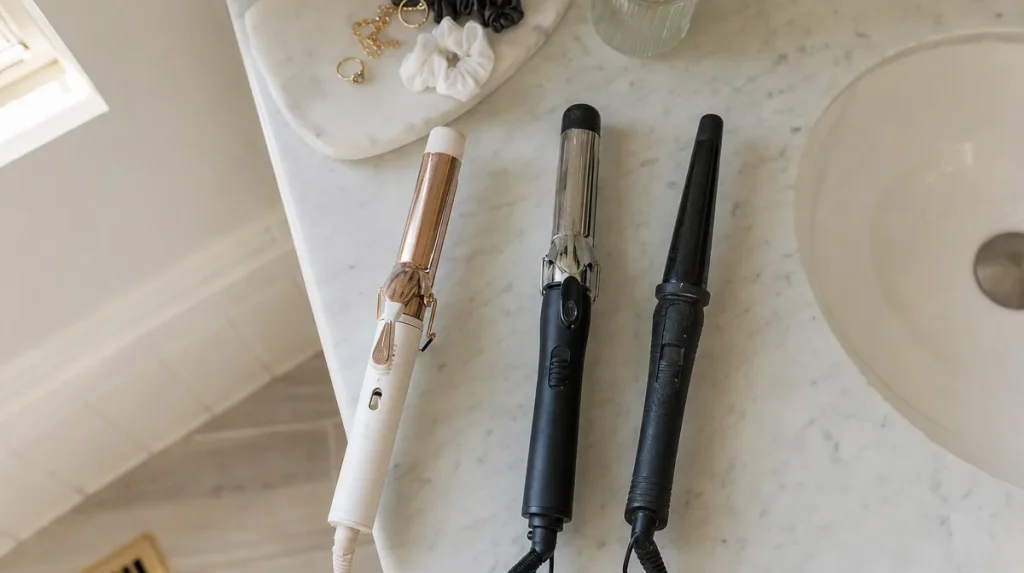
Think of a curling iron barrel the way you think of a frying pan. A rough or scratched pan sticks and burns unevenly, while a smooth one lets heat spread evenly across the surface. Hair works the same way against metal.
Ceramic barrels, and ceramic-coated ones, are popular because a smooth ceramic surface distributes heat more evenly than bare metal, which reduces hot spots that can singe a strand before the rest of the section has curled. Tourmaline is a mineral sometimes ground into the ceramic coating; as it heats, it releases negative ions that can help neutralize the static charge responsible for flyaways, a mechanism dermatology and cosmetic science literature has described in the context of ionic hair tools generally.
Titanium barrels heat up fast and hold a high, steady temperature, which is why they show up often in professional kits for thick or coarse hair that resists curling. That same speed and intensity is part of why titanium is not usually the first recommendation for fine or chemically treated hair: it has less margin for error.
The mistake most buyers make is judging the barrel by the coating’s name rather than by touch. Run a finger along a display model. A barrel that feels glassy smooth, with no ridge where the coating meets the clamp, will treat hair more gently than one that feels gritty, regardless of what the box calls it.
Matching Temperature To Your Hair’s Actual Condition
Heat styling works by softening the hydrogen bonds inside the hair’s keratin structure long enough to reshape the strand around the barrel; the bonds reset as the hair cools, which is why a curl holds better if you let it cool before touching it. Push the temperature too high, though, and you are no longer just softening bonds, you are breaking down the protein itself.
The American Academy of Dermatology’s general public guidance on heat styling notes that lower settings paired with slightly longer contact time tend to be gentler on the hair shaft than very high heat applied briefly, a point worth remembering given how many irons now market a top setting near 450 degrees Fahrenheit as a feature rather than a risk.
Fine or color-treated hair generally does best between 300 and 350 degrees. Medium hair sits comfortably around 350 to 375. Thick, coarse, or hard-to-curl hair can often tolerate 375 to 400 without visible damage, though results vary by individual hair history and prior chemical treatments.
A simple self-test: take one small, hidden section near the nape of the neck and curl it at your intended setting. If you hear a faint sizzle or smell singeing rather than simple steam from styling product, the setting is too high for that section, and you should drop it before working through the rest of your hair.
Barrel Size And The Curl You Actually Want
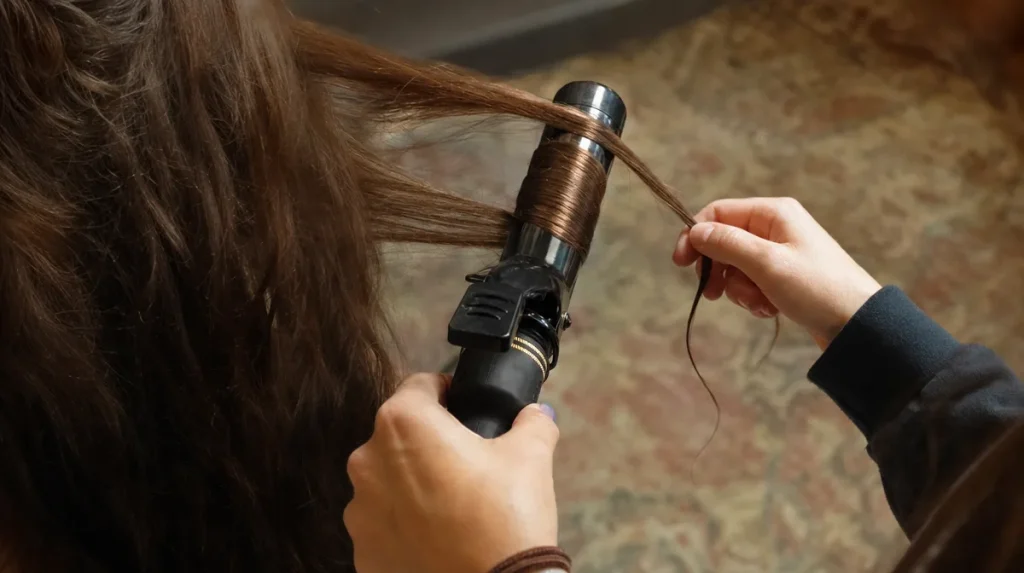
Barrel diameter behaves the way a pencil versus a broomstick behaves when you wrap a ribbon around each one. A thin barrel produces a tight, densely wrapped curl; a wide barrel produces a loose, open wave with far less wrap per inch of hair.
A three-quarter-inch or one-inch barrel gives classic, springy curls that read as more defined and, generally, hold their shape longer through the day. A one-and-a-quarter to one-and-a-half-inch barrel gives the loose, beachy wave that has dominated styling videos for years, but that same looseness means it can drop into straight hair faster, especially on second-day or freshly washed hair that has less texture to grip.
The common mistake is buying the barrel size seen in a video without accounting for hair length. Long hair wrapped on a very narrow barrel takes far more sections and far more time, and the earliest curls will have cooled and started to relax before the last section is even finished. Shorter hair on a very wide barrel may not wrap enough times to hold a visible curl at all.
A rule of thumb stylists use: match barrel size roughly to the curl diameter you want the finished style to settle into, not the diameter you want while the iron is still wrapped, since most curls loosen by about one size once they cool.
Clamp Or No Clamp: What The Debate Is Actually About
Clamped irons hold a section of hair firmly against the barrel while you wrap and hold, which makes them more forgiving for anyone still learning the motion. Clampless wands require you to hold the section against the barrel with a fingertip or a glove, which takes more practice but avoids one specific problem: the clamp line.
That line is a small crease or bend that can appear where the clamp presses the hair flat before the curl begins, especially near the ends of a section. On fine hair, or hair that is already thin at the ends, that crease can be visible even after the curl relaxes.
The mistake most people make with clamped irons is closing the clamp on too much hair at once. A section thicker than about one inch will not heat evenly all the way through; the outside curls while the inside, closer to the clamp, barely warms at all. Thinner sections, taken slowly, curl more evenly and reduce the visible clamp mark almost entirely.
Neither style is objectively better. Clamped irons suit reliability and speed for daily styling; clampless wands suit anyone chasing a softer, more undone finish and willing to spend a little longer per section to get it.
Heat-up Time And Recovery Between Curls
Heat-up time, how long an iron takes to first reach its set temperature, gets most of the attention on packaging. Recovery time matters more day to day and gets almost none.
Recovery time is how quickly the barrel returns to its set temperature after each section of hair pulls heat away from it. A well-built iron with a strong internal heating element recovers within a few seconds. A weaker one can take twenty seconds or more, which means if you are working through a full head in quick succession, later sections are curled at a noticeably lower actual temperature than the display shows, even though the display itself has not changed.
This is the mechanical reason the last few curls in a set often look looser or less defined than the first ones, an outcome many people wrongly blame on their own technique or on hair that gets progressively harder to curl toward the back of the head.
There is no easy way to read recovery time off a box. The closest proxy is wattage relative to barrel size: a barrel with high wattage packed into a small diameter tends to recover faster than the same wattage spread across a wider barrel, since there is less metal mass to reheat.
A Five-minute Self-test You Can Run In The Store
Before buying, stylists tend to check three things with their hands, not the spec sheet, and you can do the same at a display counter.
First, touch the barrel itself, cold if possible, and run a finger along its length. Any ridge, seam, or rough patch will catch hair in use, however small it looks.
Second, check the weight and where it sits. An iron that feels front-heavy, with most of its weight near the barrel rather than the handle, tires the wrist faster over a twenty-minute styling session, which matters more than it sounds like it should.
Third, if the model has a digital display, ask a staff member whether the store has a working demo unit you can turn on. Digital numbers on cheaper models can run several degrees warmer or cooler than the display claims; there is no simple external way to verify this at home short of an infrared thermometer, but a store demo at least confirms the iron heats at all and holds a setting rather than drifting.
A fourth, more informal check: listen for a fan or motor noise if the model claims ionic technology. Ionic generators typically need a small fan to disperse ions, so a completely silent “ionic” claim is worth a second look at the fine print.
Humidity, Product, And How Long A Curl Actually Survives
Curl longevity has as much to do with the air around you as with the iron in your hand. Humid air carries water vapor that hair fiber absorbs, and as it absorbs moisture, the hydrogen bonds that were reset into a curled shape gradually relax back toward straight. This is why a curl set on a humid East Coast summer afternoon can fall within a couple of hours, while the same technique on a dry winter day with indoor heating running can hold well past bedtime.
A light heat-protectant or setting spray applied before curling can help slow that moisture absorption, though how much depends on the specific product and on hair porosity, and results do vary. The Good Housekeeping Institute’s general consumer guidance on hair tool testing has long emphasized checking a product’s performance across repeated use rather than a single demonstration, a reasonable habit for any home tester as well: try a new iron on more than one hair-washing cycle before judging it, since hair fresh out of a wash behaves differently than hair on day two or three.
Setting with cool air, even just a few seconds of a cool-shot button if the iron has one, helps lock the reshaped bond before humidity has a chance to work on it, a small step that costs nothing and is skipped more often than it should be.
Marketing Words Versus What Is Actually Happening In Your Hand
Spec sheets are full of words that sound technical but describe very little. “Infrared heat” usually just means the iron emits heat as infrared radiation, which nearly all heating elements do to some degree; it is not, by itself, evidence of gentler styling. “Nano-ceramic” and “ceramic-coated” are not the same as solid ceramic, and a thin coating over a metal core can wear thin at the clamp edge faster than a solid barrel does.
“Professional-grade” has no fixed technical meaning on a retail box. “Auto shut-off” is a genuine safety feature worth having, since an iron left on and forgotten is a real fire risk, but it says nothing about styling performance.
The words worth reading closely are the plain numbers: temperature range, wattage, barrel diameter, and cord length or battery life for cordless models. Everything else on the front of the box is there to catch your eye, not to describe the mechanism inside the barrel.
A reasonable habit, before buying anything with a marketing term you do not recognize, is to look up that term specifically rather than the product name, since the same claim shows up across dozens of unrelated tools at very different quality levels.
Key Takeaways
A curling iron is not a single decision, it is several small ones stacked together: barrel smoothness, temperature matched to your hair’s condition, barrel size matched to the curl you actually want, clamp versus clampless for your skill level, and how well the iron recovers heat between sections. Price alone answers none of these questions.
A Quick Checklist Before You Buy
- Run a finger along the barrel: smooth, with no seam or ridge where it meets the clamp.
- Match temperature range to your hair type, not to the highest number on the box.
- Pick barrel diameter for the curl size you want once it has cooled and relaxed, not the size while wrapped.
- Decide clamp or clampless based on how much practice you are willing to put in.
- Check wattage relative to barrel size as a rough proxy for how fast it recovers heat between sections.
- Test any new iron across at least two hair-washing cycles before judging its real performance.
- Use a cool-shot or a few seconds of cool air to set each curl before humidity works against it.
This article is for general information and does not replace advice from a licensed stylist or dermatologist.
Individual results vary by hair type, hair history, and styling habits.