
Robert Kessler, Senior Health and Science Editor.
You’re standing at the fragrance counter, or more likely scrolling a drugstore aisle online at midnight, and you already own four half-used bottles that smelled incredible on the card and faded to nothing by lunch. That gap between the sprayed wrist and the four o’clock meeting is the whole problem. It isn’t really about taste. It’s about concentration, skin chemistry, and a few marketing words that sound scientific but mean almost nothing. One fact worth knowing before you buy another bottle: an Eau de Parfum typically holds 15 to 20 percent perfume oil, compared to roughly 5 to 15 percent in an Eau de Toilette, which is the actual reason it lasts longer, not the brand story on the box.
- Concentration, not brand prestige, drives longevity: the percentage of perfume oil in the formula matters more than the name on the label.
- Your skin changes the scent: body chemistry, pH, and even diet can shift how a fragrance reads on you versus on a testing strip.
- Testing on paper tells you the notes; testing on skin tells you the truth: a scent needs four hours on your own skin before you can judge it fairly.
What “Eau De Parfum” Actually Means
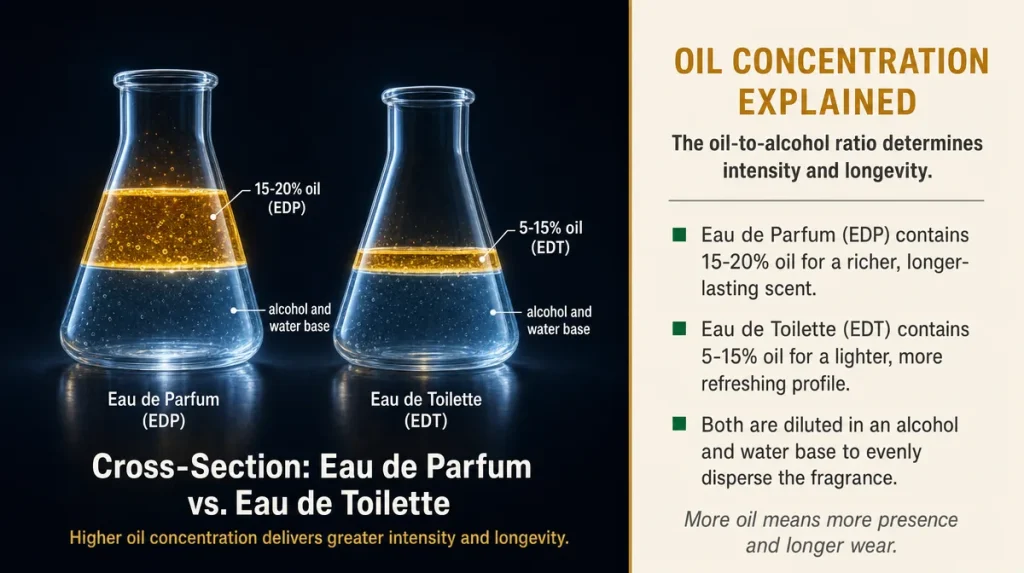
The French terms on perfume bottles are not poetry, they are concentration labels, the same way “2% milk” tells you fat content. Eau de Parfum (EDP) generally contains 15 to 20 percent aromatic compounds dissolved in alcohol and water. Eau de Toilette (EDT) usually sits at 5 to 15 percent. Parfum or extrait de parfum can run higher still, sometimes above 20 percent.
Think of it like coffee concentrate versus drip coffee. Same beans, same flavor profile, but one is diluted more than the other before it reaches the cup. A weaker dilution fades faster because there is simply less of the scent material left to evaporate slowly off your skin.
The mistake most shoppers make is assuming “parfum” on a bottle always signals luxury or higher quality. It signals dilution ratio, nothing more. A beautifully composed EDT can outperform a mediocre EDP in how good it smells, even if it fades sooner. Concentration tells you about staying power, not about whether you will like it.
Self-test: next time you’re comparing two bottles, check the box or the brand’s product page for the concentration label before you even smell either one. It will tell you more about expected wear time than any marketing copy around it.
Why The Same Perfume Smells Different On Two People
A scent that smells warm and spicy on your best friend can turn sharp and soapy on you, using the exact same bottle. This is not imagination. Skin pH, natural oil production, and even hormonal cycles change how aromatic molecules evaporate and bond to skin.
Researchers studying skin surface chemistry have noted that oilier skin tends to hold onto fragrance longer and can deepen base notes, while drier skin lets top notes fade faster and read lighter overall. Diet, medication, and even stress can shift body chemistry enough to change how a scent develops over several hours.
The practical mistake is buying based on how a fragrance smells on a friend, a sales associate, or a paper strip. None of those surfaces have your biology. A perfume is less a fixed object and more a reaction between a formula and your particular skin.
Self-test: spray a sample on the inside of your wrist and on the inside of your elbow. Compare how the scent reads in each spot after twenty minutes. If they differ noticeably, that is your own chemistry at work, and it’s a preview of how much variation you’ll see trying the same scent on different days.
Reading The Pyramid: Top, Heart, And Base Notes
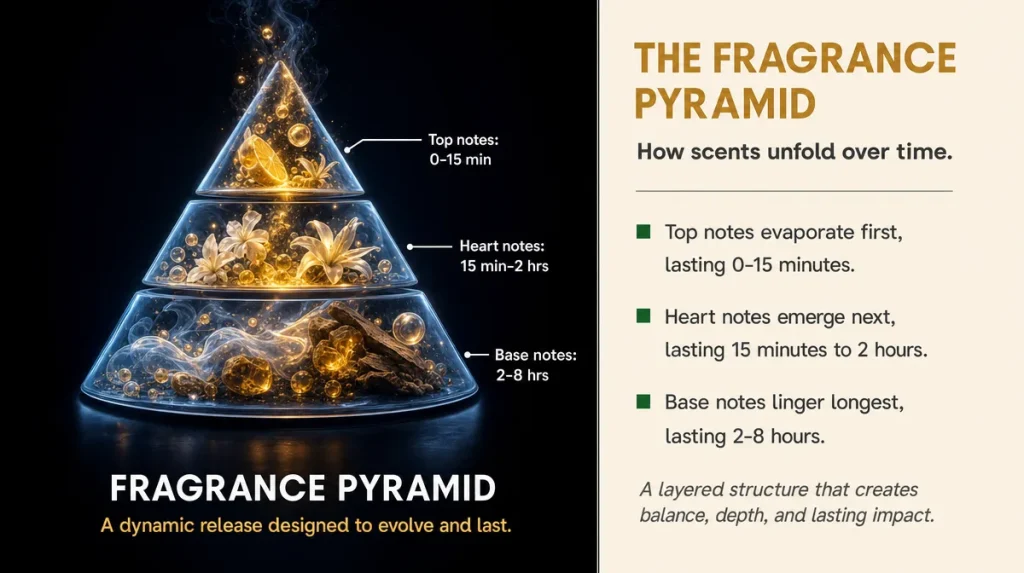
Every fragrance is built in three layers, often called the scent pyramid. Top notes are what you smell in the first five to fifteen minutes, usually citrus, light florals, or herbs. They’re designed to evaporate fast and make a strong first impression. Heart notes, sometimes called middle notes, emerge over the next hour or two: florals, spices, fruits. Base notes are the slow burners, woods, musks, amber, vanilla, that can linger for six hours or more.
Think of it like a three-course meal. The appetizer is bright and gone quickly. The main course is what you actually remember. Dessert lingers on your palate long after the table is cleared.
The common mistake is judging a fragrance entirely by its top notes, which is exactly what happens when you spray once at a counter and decide in thirty seconds. That citrus burst will be gone within the hour. What matters more for a long-term “holy grail” scent is how the base notes smell on you after four or five hours, because that’s what people around you will actually notice by evening.
Self-test: spray a sample in the morning and check in at hour one, hour three, and hour six. Write down one word for each stage. If you only like the hour-one version, you’ve found a fragrance that performs well as a first impression but may not be the one you want to commit to.
What’s Marketing And What’s Chemistry
Terms like “long-lasting,” “clean,” and “luxury blend” appear on nearly every bottle in the drugstore and department store alike, and they carry no regulated definition. “Clean” in particular has become a marketing category rather than a chemical one; it usually just means a brand has chosen to exclude certain ingredients, which says nothing about how the fragrance performs or how safe it is relative to others.
What does carry real information: the concentration percentage (when listed), the ingredient list if provided, and independent reviews that describe actual wear time rather than adjectives like “intoxicating” or “addictive.”
The Good Housekeeping Institute has long lab-tested beauty and fragrance products for wear and skin compatibility, a tradition going back to the magazine’s original consumer-protection mission. Reading how an independent lab describes longevity testing can be a useful gut check against a brand’s own claims on its packaging.
The mistake shoppers make is assuming a higher price automatically signals a more complex, longer-lasting formula. Price often reflects packaging, marketing spend, and brand positioning more than raw material cost. A $14.99 drugstore EDP can be built from the same aromatic compound suppliers used by prestige houses.
Testing Before You Buy: The Four-hour Rule
A fragrance deserves a real trial before you commit to a full bottle, and that trial should happen on your skin, not on a paper strip at the counter.
The method: spray once on your wrist or inner forearm and go about your day. Do not reapply. Check back at the one-hour, four-hour, and eight-hour marks. Note whether the scent has faded to nothing, shifted into something unrecognizable, or settled into a version you still like.
Paper strips are useful for narrowing down a shortlist quickly in a store, since they let you smell several fragrances without overwhelming your nose, but they cannot tell you how a scent interacts with your particular skin oils over the course of a day. Think of a paper strip as a menu description and your skin test as the actual meal.
The mistake most people make is buying on the spot after a single sniff at the counter, driven by the appealing top notes. A bottle bought that way often ends up half-used in a drawer within a month, which is exactly the shelf most of us are trying to avoid adding to.
Self-test: before your next purchase, ask for a sample vial or spray a tester at home and commit to the eight-hour check-in. If a fragrance still smells good to you by evening, it has passed the only test that matters.
Matching Fragrance To Season And Skin Type
Humid summer air and dry, heated winter air change how fragrance behaves on skin, and this is especially true along the East Coast, where summer humidity can make a scent bloom bigger and faster, while dry indoor heating in winter can mute a fragrance within an hour.
Lighter, citrus-forward or green EDTs tend to hold up better in humid months, since heavy humidity already amplifies projection on its own. Richer, warmer EDPs with amber or woody base notes often perform better in dry winter air, when skin needs more help holding onto scent molecules.
Skin type matters too. Drier skin generally benefits from applying a fragrance-free lotion first, since hydrated skin holds scent longer than dry, flaky skin where molecules have nothing to bind to. Oilier skin tends to need less reapplication throughout the day.
The mistake is buying one “signature scent” and expecting it to perform identically across all twelve months. A seasonal rotation, even just two bottles, one lighter and one heavier, solves more longevity complaints than any single “long-lasting” formula claim on a label.
Layering And Storage: The Quiet Technique That Changes Everything
Fragrance layering, using a matching or complementary scented body lotion underneath a spray, is one of the simplest ways to extend wear time, and it has nothing to do with buying a stronger formula.
The mechanism is straightforward: the lotion creates a moisturized surface that holds fragrance molecules longer than dry skin does, similar to how a damp sponge holds onto soap longer than a dry one. Apply the lotion first, let it absorb for a minute or two, then spray the EDP on top, focusing on pulse points: wrists, inner elbows, the base of the throat.
Storage matters just as much as application. Heat, light, and humidity all break down aromatic compounds over time. A bottle kept on a sunny windowsill or in a steamy bathroom can lose its top notes within months. The American Academy of Dermatology has published general guidance on storing topical products away from direct heat and light to preserve stability, a principle that applies equally well to fragrance.
The mistake is displaying a beautiful bottle on a vanity near a window for the aesthetic, only to find the scent has flattened by the following season. A cool, dark drawer is unglamorous but it is the only place a fragrance should actually live.
Reading Ingredient Lists Without A Chemistry Degree
Fragrance ingredient lists are often shorter and vaguer than skincare labels, frequently ending in the single word “fragrance” or “parfum,” which can legally stand in for a proprietary blend of dozens of compounds. This is standard practice across the industry and is not, by itself, a red flag.
What’s worth scanning for: alcohol denat., which is the carrier in most sprays and evaporates quickly, and specific named aromachemicals if a brand does disclose them, which can hint at the composition’s backbone, citrus oils for brightness, musks for base longevity, and so on.
For anyone with sensitive skin or a history of reactions, a patch test on the inner forearm 24 hours before full application is a reasonable precaution. Dermatologists commonly recommend this approach for any new topical product, fragrance included, since fragrance is among the more common causes of contact skin irritation.
The mistake is assuming a short ingredient list always means a “cleaner” or safer formula. Brevity on a label often reflects proprietary protection of a formula, not a reduced risk profile. If skin sensitivity is a real concern, patch testing tells you more than reading the label ever will.
Key Takeaways
Concentration percentage, not brand reputation, is the most reliable predictor of how long a fragrance will last on skin. Your own body chemistry changes how any scent develops, which is why testing on a friend or a paper strip never substitutes for testing on yourself. A fair trial means checking in at one hour, four hours, and eight hours, not deciding at the counter. Season and skin hydration both affect performance, so a single signature scent may need a lighter or richer counterpart depending on the time of year. Layering with an unscented or matching lotion, and storing bottles away from heat and light, extends both wear time and shelf life without buying anything new.
A Quick Checklist Before You Buy
- Check the concentration label (EDP generally outlasts EDT)
- Spray on your own skin, not a paper strip, before deciding
- Wait and check back at one hour, four hours, and eight hours
- Consider the season: lighter for humid months, richer for dry winter air
- Apply over moisturized skin for longer wear
- Store the bottle in a cool, dark place, away from windows and steamy bathrooms
- Patch test 24 hours ahead if you have sensitive skin
This article is for general information only and does not replace advice from a dermatologist or allergist.
Individual results and skin reactions vary; patch testing is recommended before full use of any new fragrance.