
Robert Kessler, Senior Health and Science Editor.
The drawer under the bathroom sink tells the real story. Six palettes, maybe eight, most of them touched twice. A shimmer strip scraped down to the pan, a dozen mattes still shrink-wrapped flat because nobody could figure out what to do with a rust orange on a Tuesday morning. The question that actually gets typed into a search bar at 7 a.m. is not “best eyeshadow palette.” It is closer to “why do I own so many of these and still have nothing to wear.”
Here is the useful fact first: a palette does not fail because the shades are wrong. It fails because almost nobody is taught how to read one before buying it, the way you would read a recipe before buying ingredients. Pigment load, particle size, and shade logic matter more than the number printed on the box. This guide walks through what to check with your own eyes in the store, what the marketing language is actually telling you, and which habits quietly waste money every season.
- Your undertone decides more than the trend colors do: a warm-toned palette can sit unused for years if your skin leans cool, no matter how popular the shade names are.
- Fallout and blendability tell you more than swatch photos ever will: the only honest test happens on your own lid, in daylight, with your own finger.
- Three well-chosen shades outperform twelve mediocre ones: a transition, a lid shade, and a definer cover most everyday looks, and everything else in a palette is often just padding.
Finding Your Undertone In Daylight

Store lighting is built to flatter packaging, not skin. Fluorescent overheads flatten warm and cool tones into the same beige, which is why a shade that looked neutral under those lights can read distinctly orange or pink once you step outside.
The simplest check costs nothing. Look at the underside of your wrist near a window. Greenish veins generally mean a warm undertone, blue or purple veins usually mean cool, and a mix of both often signals a neutral undertone that can wear either direction without much trouble.
A second check: hold a piece of silver jewelry next to your face, then gold. One will look like it is lighting you up, the other like it is sitting on top of you. That contrast is your answer more reliably than any quiz.
The mistake almost everyone makes is swatching in a store under warm halogen spotlights designed to make bronze and copper tones glow, then being surprised at home when the same shade looks muddy under a bathroom’s cooler bulbs. Self-test while you read this: step near a window right now and check your wrist. If you already own a palette you never reach for, there is a decent chance its undertone fights yours rather than matching it.
Reading A Palette’s Shade Map Before You Buy
A well-built palette is organized like a spice rack: a few base notes, a couple of middle tones, and one or two accents meant to be used sparingly. Base shades are usually the lightest mattes, meant for the brow bone and inner corner. Middle tones carry most of the actual color work. The darkest, most pigmented shades are accents, meant for the outer corner or a thin line along the lash.
Many palettes marketed around a big shade count are front-loaded with near-identical middle tones and short on usable bases or definers. Counting how many shades you could realistically wear in a single look, rather than how many are printed on the box, is a better measure of value.
The mistake here is buying for the one standout shade in the center of the layout while ignoring that the surrounding shades do not build toward anything coherent. A palette with four unrelated shimmers and one workable matte is not really a palette, it is a single eyeshadow with expensive neighbors.
Before buying, trace a finger across the pans in the order you would actually apply them: lightest to darkest, left to right or top to bottom. If that path does not form a sensible progression, the shade map was built for a swatch photo, not for a face.
Why Shimmer And Matte Behave Differently On The Lid
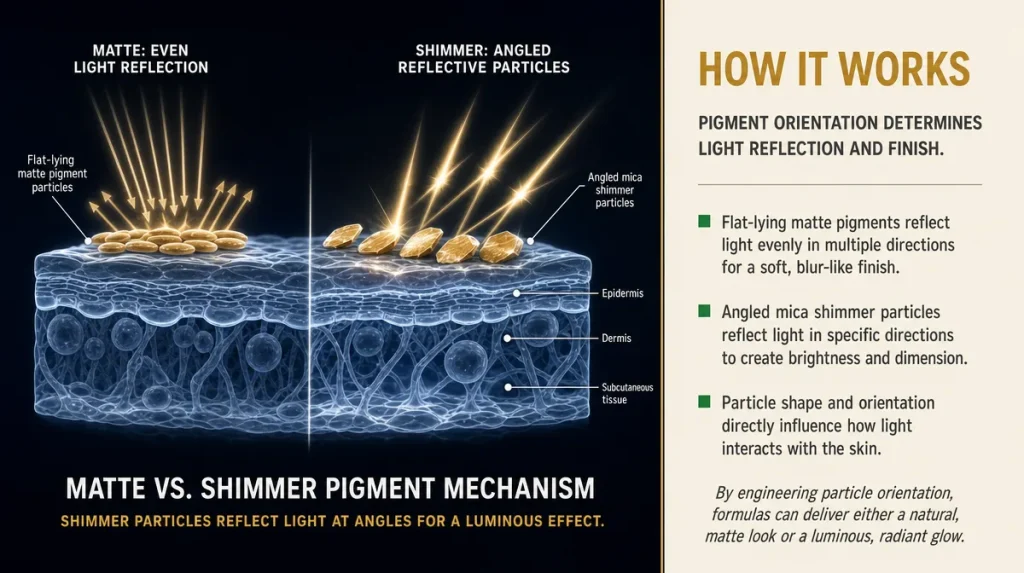
Matte and shimmer shadows are built from the same basic pigments but milled and bound differently, and that difference changes how they sit on skin. Matte pigment is ground fine and reflects light evenly across its surface, the way a sheet of plain paper does. Shimmer and metallic finishes contain mica particles cut at an angle, which catch and bounce light the way a sequin does rather than diffusing it.
That is also why shimmer tends to fall out more during application. Larger, angled particles do not cling to the fine hairs and texture of the eyelid the way finely milled matte pigment does, so a portion drops before it ever sets.
A 2021 study in the Journal of Cosmetic Science examining pressed eyeshadow formulations found that particle size distribution, not pigment concentration alone, was the strongest predictor of both fallout and wear time across tested samples.
The practical takeaway is to pack shimmer on with a flat, dense brush rather than sweeping it, which reduces the distance loose particles travel before they land. Mattes can be swept and blended more freely because the pigment stays closer to where you place it. Testers checking a new palette should press, not drag, any shimmer shade and watch how much settles under the eye before deciding it is unusable.
The Pan Test: Judging Pigmentation Before You Commit
Pigmentation claims printed on packaging describe the shade under ideal conditions, usually a single dense swipe photographed with professional lighting. The only test that matters happens on your own skin.
Swatch with a finger first, since finger heat and natural oils give a more honest read of how a shade will behave once it meets the oils on your own lid, which are typically warmer and oilier than the back of your hand. One swipe should tell you whether the shade needs heavy building to show up. If it takes three or four passes just to register a visible color on the inner wrist, it will likely need the same effort, or more, on the eyelid, where blending disturbs the pigment as you go.
Tap off excess before applying rather than wiping it on directly. A shade that looks intensely pigmented straight from the pan but goes patchy once tapped and applied properly is telling you something about how it will wear through a full day, not just how it photographs in the store.
The common mistake is judging color on the back of the hand, which tends to be drier and less oily than an eyelid, so a shade can look perfectly matte and long-wearing there and still crease or fade within a couple of hours on the actual lid. If you own a palette already, do this test now on one eye before reaching for it again.
Building A Core Three-shade System
Most everyday eye looks use three roles, not twelve shades: a transition shade to soften the crease, a lid shade to add the main color, and a definer to deepen the outer corner or line the lash.
Editorial guides, including Byrdie’s beauty tutorials, have repeatedly broken eye looks down into this same three-step structure because it maps onto how the eye socket actually reads from a distance. A transition shade close to your skin tone blurs the edge where color starts, a mid-tone lid shade carries the look, and a deeper definer adds contour without needing a steady hand for precise lines.
Once you can name which pan in a palette fills each of those three roles, you can judge the whole product in under a minute, in the store, before buying. If a palette cannot supply all three roles convincingly, it will likely sit in the drawer next to the others.
The mistake is buying palettes shade by shade, chasing one standout color at a time, which is how a collection ends up with eight transition shades and no usable definer. A faster path to a working collection is picking one well-built three-role palette and wearing it until you genuinely know what is missing, rather than guessing in advance.
Where A Blending Brush Actually Changes The Result
Brush shape changes outcome more than brush price does. A flat, dense brush packs pigment onto a small area and holds its edge, which is what you want for a lid shade or a definer along the lash line. A fluffy, tapered brush picks up very little pigment and instead pushes existing color around, softening the line between shades, which is the job a transition shade needs done.
Using the same fluffy brush for both jobs is the single most common reason a look ends up washed out: the brush that is built to soften color is being asked to deposit it, and it simply cannot hold enough pigment to do that well.
A simple test: tap a brush into a shade, then tap it once against the back of your hand. A packing brush should leave a visible, defined mark. A blending brush will leave a faint, diffuse one. If your blending brush leaves a sharp mark, it is actually a packing brush doing double duty, and your crease work will likely look harder-edged than intended.
You do not need a full brush set to use a palette well. Two brushes, one dense and one fluffy, cover the three-shade system described above for most everyday looks.
Marketing Language Worth Ignoring
A shade count printed on the front of a palette describes quantity, not usefulness. A twenty-four shade palette built around a single trend color often contains a dozen near-duplicate mid-tones and only two or three shades that behave differently enough to serve distinct roles.
Words like “baked” or “pressed from powder” describe a manufacturing method, not a performance guarantee. Baking can affect texture and finish, but it does not by itself determine pigmentation or wear time, which depend more on the particle size and binder discussed earlier.
“All-day wear” claims are rarely tested against the conditions that actually break shadow down: humidity, oil production, and friction from glasses or touching the eye area. A fair personal test runs eight hours under your normal day, not a photograph taken five minutes after application.
The Good Housekeeping Institute’s lab testing approach to cosmetics, which has evaluated wear claims on products for decades, generally measures performance under set conditions over time rather than taking a single snapshot, a useful model for judging any palette at home. Wear a new shade through a full workday once before deciding it earns a place in rotation, and track whether it creased, faded evenly, or held its edge.
When To Replace A Palette, And When Not To
Pressed powder eyeshadow does not spoil the way liquid or cream products can, since there is little water content for bacteria to grow in. A palette can often be used well past the point where a liquid foundation would need tossing.
That does not mean indefinitely. General hygiene guidance from the American Academy of Dermatology on eye-area cosmetics notes that sharing eye makeup, using it near an active eye infection, or applying products with visibly broken or contaminated surfaces raises real risk of irritation or infection, regardless of how the product otherwise looks.
Texture is the better signal than age for powder shadows. If a pan has developed a hard, cracked surface, if it has visibly changed color, or if it smells different than it did when new, those are reasons to retire it. A shadow that still swatches and blends the way it did when purchased, with no visible contamination, generally does not need replacing on a fixed schedule.
Brushes and applicators matter as much as the product itself. Washing brushes regularly reduces the transfer of oil and bacteria into a palette far more than any ingredient in the formula does, which is a simpler habit than replacing products on a calendar.
Key Takeaways
A palette earns its place in a routine by covering a transition, lid, and definer role convincingly, not by the number of pans it contains. Undertone decides whether a shade gets worn at all, and daylight near a window is a more honest judge of that than any store display. Shimmer and matte shadows behave differently because of particle size, not because one is inherently better, and that difference should guide which brush and application method you reach for. Marketing language around shade count and wear claims describes the packaging more than the product, so a personal eight-hour test still beats any label.
A Quick Checklist Before Buying A New Palette
- Check undertone against daylight, not store lighting, before judging whether warm or cool shades suit you.
- Trace the shade layout with a finger to confirm it builds from light to dark in a sensible order.
- Swatch with a finger, tap off excess, and judge pigmentation after one pass, not three.
- Identify which pan serves as transition, lid, and definer before deciding the palette is worth owning.
- Wear any new shade through a full day once before trusting a wear-time claim.
- Retire a pan for cracked texture, visible contamination, or changed smell rather than by age alone.
This guide offers general information and is not a substitute for individual professional advice.
Results and personal preferences vary from person to person.