
Robert Kessler, Senior Health and Science Editor.
You already know the drawer. Three or four tubes of liquid lipstick, each one promising eight, twelve, even twenty-four hours of wear, each one now a crusty stub because it faded by lunch, transferred onto a coffee cup, or cracked at the corners of your mouth by mid-afternoon. You type some version of the same question into your phone every few months: which long-wear lipstick actually lasts. The honest answer has less to do with the name on the tube than with a handful of things you can check yourself, in under a minute, at a drugstore counter or your own bathroom mirror.
Here is the one mechanical fact worth knowing before anything else. True long-wear formulas hold color the way a coat of paint holds to a wall: they dry down into a thin, flexible film. An old-fashioned cream lipstick, by contrast, just leaves a greasy layer of pigment sitting on the surface of your lips, waiting to be wiped off by a napkin or a sandwich. Once you understand that one mechanism, most of what separates a lipstick that survives a full workday from one that doesn’t becomes visible to the naked eye. No lab required, just a little attention to what you’re actually looking at on the shelf.
This guide walks through how that film forms, how to read a shade and an ingredient list without getting fooled by marketing language, and how to run your own quick tests before you ever leave the store.
- Long wear comes from film-forming polymers, not wax or heavy pigment, so a formula that dries to a flexible, low-shine finish within about sixty seconds is doing the actual work; one that stays glossy and movable is a cream lipstick wearing a long-wear label.
- Undertone testing in daylight beats any online shade quiz, because fluorescent store lighting and phone screens both shift how a red or a berry actually reads against your skin.
- A one-minute tissue-press test predicts real-world transfer better than any claim printed on the box, and you can run it standing at the counter before you buy anything.
What ‘Long-wear’ Actually Means On The Label
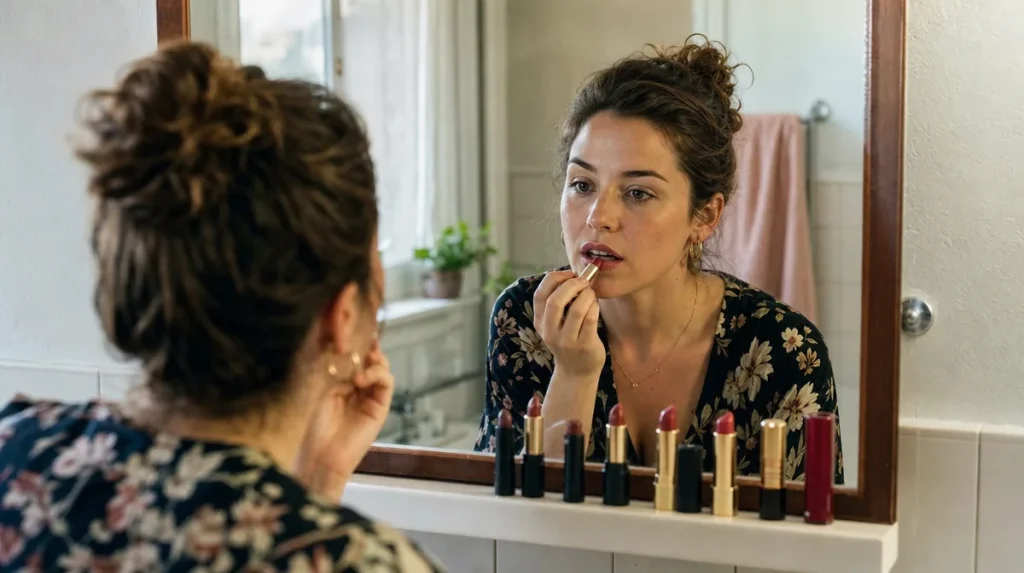
Every brand prints a wear-time claim somewhere on the box: eight hours, twelve, transfer-proof, kiss-proof. None of those numbers are regulated the way a drug claim would be, so they tell you almost nothing about what will happen on your particular lips.
What matters is the mechanism underneath the marketing word. Genuine long-wear liquid lipsticks are built around film-forming polymers, ingredients that start out as a fluid suspension and then dry down into a thin, matte or semi-matte layer that sits close to the skin rather than moving around on top of it. Think of it the way a fresh coat of paint behaves on a wall. Wet, it smears if you touch it. Cured, it holds its shape through a rainstorm.
A formula built mainly on wax and oil, even one marketed as long-wear, behaves more like the wet paint. It looks similar in the tube and even in the first few minutes on your lips, but it never fully sets, so it keeps transferring for hours.
Here is a self-test you can do in the store. Swipe a small amount on the back of your hand and count to sixty. A true film-forming formula will visibly change texture: it goes from glossy and movable to a slightly stiffer, flatter finish you can barely feel with a fingertip. If it still smears the same way at sixty seconds as it did at five, you are likely holding a cream lipstick in long-wear packaging.
Finding Your Undertone Before You Pick A Shade
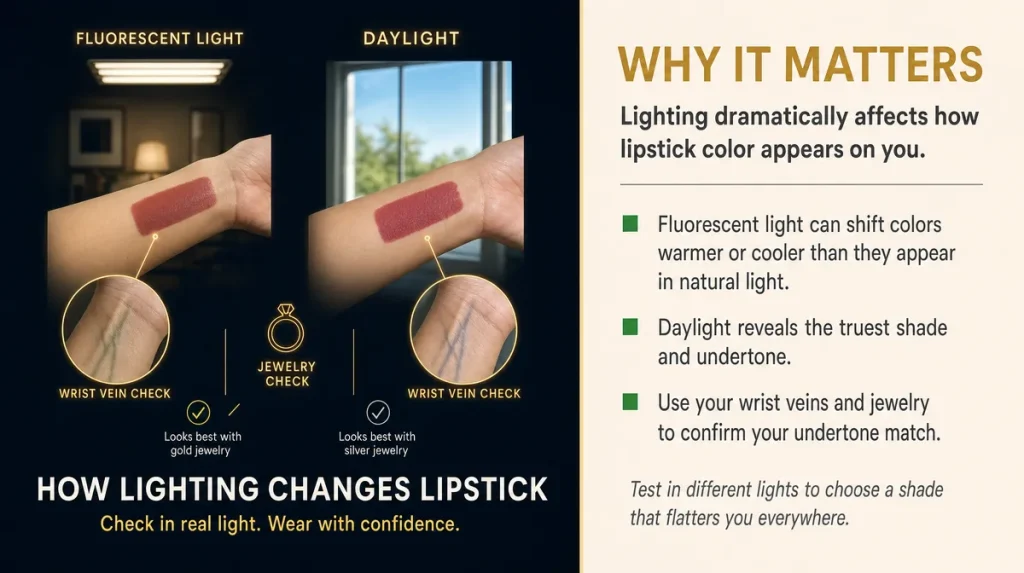
Most shade regret has nothing to do with wear time. It happens because the color looked right under store lighting and wrong the moment you stepped outside.
Fluorescent lighting and phone camera screens both push colors toward blue or yellow in ways that daylight does not. The fix is simple: before you commit to a shade, swipe it and step near a window, or check it against a mirror in natural light if you’re already home.
Undertone, separate from shade depth, decides which family of reds, berries, or nudes will look alive on you versus chalky or muddy. A quick way to check: look at the veins on the inside of your wrist in daylight. Green-leaning veins usually point to a warm undertone, blue or purple-leaning veins to a cool one, and a mix of both to neutral. Jewelry offers a second data point: gold that seems to glow against your skin generally signals warm, while silver that looks cleaner than gold signals cool.
Once you know your undertone, shade names across the fair, light, medium, tan, and deep range become far easier to navigate on sight, because you are narrowing a whole wall of options down to one lane instead of guessing from scratch every time.
A mistake worth naming here: matching a lipstick to a lip liner or gloss you already own, rather than to your skin. Liners and glosses fade at different rates, so building a look around one product’s leftover shade tends to produce a mismatch by the time the lipstick itself has set.
Reading The Ingredient List Like A Chemist Would
You do not need a chemistry degree to read a lipstick label usefully. You need to know what three categories of ingredients are doing and roughly where they should sit on the list.
Pigments and dyes give color and usually sit toward the middle of the list, since concentration determines order. Film formers, often silicone-derived polymers or certain acrylate copolymers, are the ingredients doing the actual long-wear work described above; their presence near the top of the list is a reasonable clue that wear performance was a real design priority, not an afterthought.
The third category, emollients and oils, is where formulas diverge the most. A liquid lipstick with almost no oil or emollient content will dry fast and resist transfer aggressively, but it is also the formula most likely to feel tight, flaky, or uncomfortable by hour four, particularly in a dry winter with indoor heating running. A formula with a bit more emollient content trades a slightly softer set for comfort over a long day.
High alcohol content near the top of an ingredient list is worth noting rather than avoiding outright: it speeds drying but can also speed dehydration on already dry or chapped lips. A 2022 study in the International Journal of Cosmetic Science examining lip cosmetic formulations noted that faster-drying film formers were associated with higher reported dryness among users with a history of chapped lips, which is a useful thing to know about yourself before you buy.
None of this requires memorizing chemical names. It just means glancing at the first five or six ingredients rather than trusting the front of the box.
The Mistakes That Make Liquid Lipstick Fail By Lunch
Most premature fading has less to do with the formula than with how it was applied.
The most common mistake is applying too much product in one pass. A thick layer takes longer to fully cure into its film, and a film that never finishes setting stays vulnerable to transfer for hours. A thin, even layer, allowed to dry fully before a second pass if you want more depth, sets faster and holds longer.
The second mistake is moving too soon. Eating, drinking, or pressing your lips together within the first sixty to ninety seconds after application interrupts the drying process at the exact moment the film is forming. Give it the full minute before you do anything with your mouth.
The third, less obvious mistake is skipping lip prep. Flaky or peeling skin creates an uneven surface, and a film-forming formula will crack along those flakes the way dried mud cracks along uneven ground. A gentle exfoliation the night before, followed by a light balm that has fully absorbed before you apply lipstick the next day, gives the film a smoother surface to bond to.
A fourth habit worth mentioning: over-exfoliating in the days leading up to a big event, out of a desire for perfectly smooth lips. Lip skin has no oil glands and repairs slowly, so aggressive scrubbing close to the day you actually want long wear can leave the surface more irritated and uneven than if you had left it alone.
How To Judge Transfer-resistance Yourself, At Home
You can predict a lot about how a liquid lipstick will behave over a workday using nothing more than a tissue and a coffee cup, before you ever leave the counter.
The tissue-press test: apply the lipstick, let it set for a full sixty seconds, then press a tissue firmly against your lips once. A formula performing as advertised will leave little to no color on the tissue after that first press. Repeat the press a second time in the same spot. If color transfers heavily on the second press rather than the first, the formula is behaving more like a cream lipstick with a matte finish than a true long-wear film.
The cup test, useful if you are already wearing a shade you’re deciding whether to repurchase: drink from a glass or cup rim with your natural lip pressure, not a careful sip. Genuine film-forming formulas tend to leave a faint outline at most, while wax-based formulas leave a visible ring of full-strength color.
The hour test matters more than any in-store test, though it takes patience. Apply in the morning and check in a mirror around midday, before eating lunch. Look specifically at the corners of the mouth and the center of the lower lip, the two spots that take the most friction during a normal day and the first places any formula will show wear.
None of these tests requires buying anything first. Most stores will let you swatch on the back of your hand or, with a clean applicator, directly on your lips.
What Matters Vs. What Is Marketing On The Box
Certain words on a liquid lipstick box are doing real work. Others are doing almost none.
‘Transfer-resistant’ and ‘film-forming’ point to an actual mechanism, the one described earlier in this guide, and are worth taking seriously as buying signals. ‘Long-wear’ and ‘all-day’ are vaguer: they describe an intention rather than a tested outcome, since wear time depends heavily on what you eat, how humid the day is, and how much you touch your face.
Numbered wear-time claims, twelve hours, sixteen hours, and so on, are the least reliable piece of information on the box. These figures typically come from internal testing under controlled conditions that rarely resemble an actual day: eating, drinking, talking, weather. The American Academy of Dermatology has noted in public guidance on lip care that lip skin is thinner than facial skin and lacks oil glands, which means it behaves differently across individuals and across seasons in ways a single number on a box cannot capture.
‘Dermatologist-tested’ and similar phrasing on a box usually indicates a safety patch test, not a performance guarantee. It is worth knowing the difference: a formula can be perfectly safe and still fade by 2 p.m.
One practical rule of thumb: the more specific the claim is about mechanism (film-forming, polymer-based, sets in sixty seconds) the more useful it tends to be. The more specific the claim is about a round number of hours, the more skeptical you should be, since that number was almost certainly generated under ideal conditions that do not include lunch.
Matching Formula To Season And Skin Type
The same liquid lipstick can perform very differently depending on the time of year, which is worth building into how you shop rather than treating as a fluke.
Humid East Coast summers push moisture into everything, including a drying lip film, which can shorten wear time and increase the chance of light transfer even from a well-formulated product. A slightly more matte, faster-setting formula tends to hold up better in that kind of weather.
Dry winters with indoor heating running create the opposite problem: the same fast-drying formula that performed well in July can feel tight, flaky, or uncomfortable by January, because there is less ambient moisture and the lips themselves tend to be drier. A formula with a touch more emollient content, or a habit of applying a hydrating balm underneath and letting it fully absorb first, tends to solve this without giving up much wear time.
Skin type interacts with this too. Lips that run naturally dry will show cracking along a matte long-wear film faster than lips that stay naturally more hydrated, particularly once the pumpkin-spice-and-sweater-weather stretch of fall sets in and temperatures start swinging between warm stores and cold outdoor air.
A reasonable approach, rather than owning one long-wear lipstick for the whole year, is treating the format the way you might treat a moisturizer: one lighter, faster-drying formula for humid months, one slightly richer formula for dry ones. It is a small adjustment, but it addresses the actual variable, which is moisture in the air, rather than assuming any single formula should perform identically in July and January.
How Long Results Should Realistically Last, And When To Stop
A well-formulated long-wear liquid lipstick, applied correctly and left undisturbed for the first minute, can reasonably be expected to hold most of its color through a typical workday of talking, drinking water, and a light meal. Full twelve-hour claims printed on packaging describe a best-case scenario, not a guarantee, and results vary meaningfully by individual, weather, and how much you touch your face.
Fading tends to follow a predictable pattern rather than happening all at once. The center of the lower lip and the inner edge closest to the teeth typically lighten first, since those spots take the most friction from eating and talking. A slightly patchy, uneven fade toward the end of the day is normal and does not necessarily mean the formula failed. A lipstick that comes off in one clean swipe within an hour or two, by contrast, likely never finished forming its film in the first place.
It is worth paying attention to how your lips feel, not just how the color looks. Persistent tightness, flaking, or stinging after repeated wear of a particular formula is worth taking seriously. Mayo Clinic’s general public guidance on lip care notes that ongoing irritation from a cosmetic product is a reasonable signal to discontinue use and, if it persists, to have it evaluated rather than assuming it will resolve on its own.
As a rule, if a formula leaves your lips more uncomfortable at the end of most days than they were before you started wearing it, no amount of wear time is worth trading for that.
Key Takeaways
Long wear comes from a film drying on your lips, not from heavy pigment or wax sitting on top of them. You can see this happen in under a minute if you know to watch for it.
Undertone and daylight testing matter more than any shade name printed on a tube. A color that looks right under store lighting can look wrong the moment you step outside.
The tissue-press test, run at the counter before you buy anything, predicts real-world transfer better than any number printed on the box.
Season changes the right formula. What holds up in a humid August will not necessarily feel comfortable in a dry January, and that is a formulation issue, not a personal failing.
Comfort is information. Persistent tightness or flaking from a particular formula is worth listening to, regardless of how long the color itself lasted.
A Quick Checklist Before You Buy
- Check your undertone in daylight, not under store lighting or on a phone screen.
- Swipe on the back of your hand and count to sixty. Look for a visible shift from glossy to set.
- Press a tissue against the swatch twice. Minimal transfer on the second press is a good sign.
- Scan the first five or six ingredients rather than the front of the box.
- Apply in a thin, even layer and wait a full minute before eating, drinking, or pressing your lips together.
- Prep lips the night before with gentle exfoliation and a fully absorbed balm, not the morning of.
- Match formula weight to the season: lighter and faster-setting in humid months, more emollient in dry ones.
- Pay attention to comfort over the full day, not just how the color looks in a midday photo.
This article is for general information only and is not a substitute for professional dermatologic advice.
Individual results vary depending on skin type, application, and environmental conditions.