
Danielle Ferraro, Beauty Editor.
You are standing at the bathroom mirror at 7:40 a.m., phone timer already counting down, staring at hair that looks flat at the crown and slightly greasy along the part. There is a can of dry shampoo under the sink, half used, the nozzle crusted with white residue. You spray it anyway, wait ten seconds, and it does almost nothing. This happens to most people not because the product is weak, but because dry shampoo is one of the most misused items in the average bathroom. A 2021 survey cited by Byrdie found that a majority of women apply it wrong: too close to the scalp, right before they need to leave, with no brushing afterward. Fix the technique and the can you already own will likely outperform whatever expensive version replaces it. This guide walks through exactly how.
- Timing beats product: applying dry shampoo the night before, not the morning of, gives the starches time to absorb oil instead of just sitting on top of it.
- Distance and dosage matter more than formula: holding the can too close deposits visible powder; six to eight inches away with short bursts spreads it evenly.
- Brushing it out is not optional: skipping the brush-through step is the single biggest reason dry shampoo looks chalky or does nothing at all.
Why Dry Shampoo Fails At The Roots
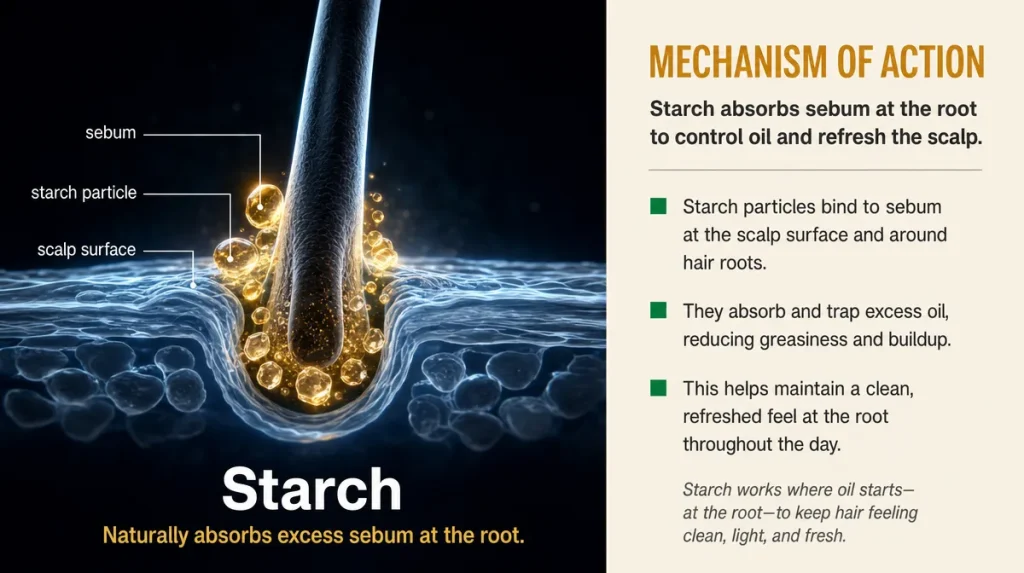
Dry shampoo is not a cleanser. It does not remove oil the way water and surfactant do in the shower. It is closer to a very fine flour: rice starch, corn starch, or silica particles that absorb sebum and sit on the hair shaft until they are brushed or shaken out.
Think of it the way a baker thinks of flour on a wet countertop. Sprinkle flour on a puddle and it clumps into paste if you leave it there. Sweep it while it is still working and it lifts the moisture away, leaving the surface dry. Dry shampoo behaves the same way. Left untouched, the starch particles bind with oil and sit visibly on the scalp, which is why so many people complain about a gray cast or a chalky smell.
The other failure point is timing relative to sebum production. Scalp oil is not static. It builds gradually through the day as sebaceous glands respond to temperature, hormones, and touch. Applying dry shampoo onto hair that has almost no oil yet, first thing in the morning, means the starch has nothing to absorb and nowhere to go except sit on top of clean strands, looking obvious rather than invisible.
Understanding this mechanism changes how you use the product entirely. It is not a finishing spray to reach for in a rush. It is closer to a treatment that needs a few minutes, sometimes a few hours, to actually do its job.
The Night-before Rule: When To Actually Spray It
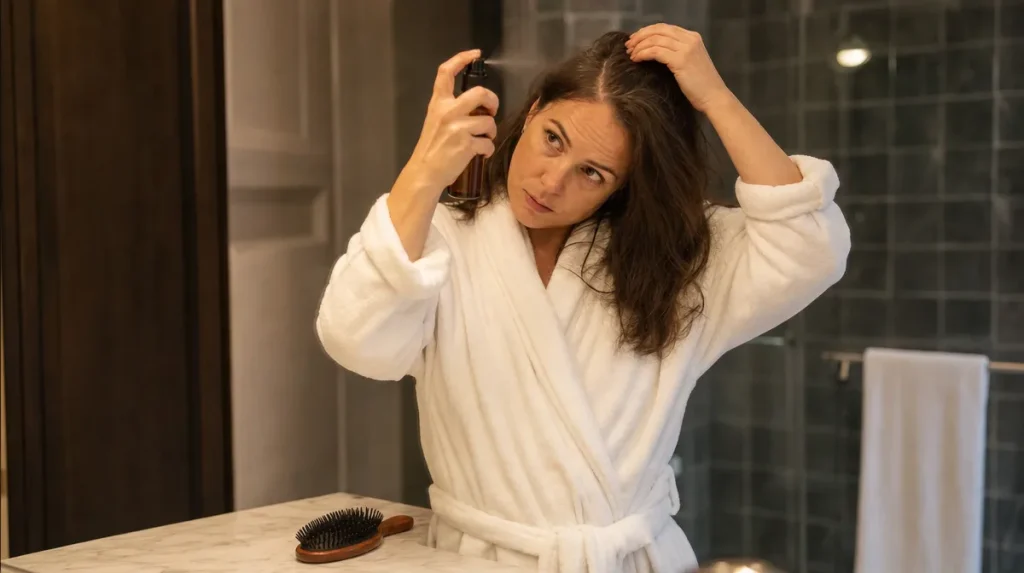
The single biggest technique fix is timing. Most people spray dry shampoo in the ten minutes before leaving the house, which is exactly the window when it works least well.
Hair that was washed the previous evening and sprayed lightly at the roots before bed gives the product six to eight hours to absorb oil as it accumulates overnight. By morning, a quick brush-through distributes any residue and the roots look lifted rather than powdery.
For hair that is already a day or two past washing, apply in the morning but build in a five-minute gap between spraying and styling. Brush your teeth, make coffee, then come back and brush the hair out. That gap is when the starch is actually absorbing oil rather than just sitting there.
A common mistake is treating dry shampoo as an emergency fix, sprayed and styled over in under a minute. Dermatologists writing in general public guidance from the American Academy of Dermatology note that most scalp and hair care products need a short dwell time to work as intended, the same logic that applies to leave-in treatments. Dry shampoo is no exception, even though the can makes it feel instant.
If mornings never allow for a gap, the night-before method solves the problem without adding any extra step to your actual morning routine.
Distance And Dosage: The Flour-dusting Mistake
Hold the can too close and you get exactly what you are trying to avoid: visible white patches at the root, especially on medium to deep shades where light powder shows up fast.
The right distance is six to eight inches from the scalp, roughly the length of a dollar bill held end to end. Section the hair with your fingers or a comb, spray in short one-second bursts along the part, then move the section over and repeat. Long, continuous spraying in one spot is how people end up with a paste-like buildup that no amount of brushing fixes that day.
Dosage matters as much as distance. Most people use two to three times more product than necessary because they are chasing an immediate visual change. Less product, applied closer to bedtime with time to absorb, consistently outperforms a heavy morning dose.
For fine or fair hair, aerosol sprays tend to distribute more evenly than powder formulas poured directly, since the propellant breaks the starch into a finer mist. For coarser or deeper shades, a tinted dry shampoo formulated for darker tones reduces the gray-cast problem, though the technique underneath does not change: light dose, sufficient distance, brushed out.
Brushing It Out: The Step Everyone Skips
Ask anyone who has been disappointed by dry shampoo whether they brushed it through, and the honest answer is usually no, or barely.
Brushing does two things. It distributes the starch away from the root, where it can otherwise sit as a visible layer, and it physically lifts the hair shaft at the crown, which is most of what people are actually chasing when they complain about flat roots. The product absorbs oil; the brush creates the lift.
Use a boar-bristle or mixed-bristle brush rather than a fine-tooth comb. Bristles distribute product along the shaft; a comb mostly just parts hair. Work in sections, brushing from root to mid-length, and finish with your fingers massaging the scalp lightly at the crown to add volume.
A useful self-test: after spraying and waiting the recommended few minutes, run a finger along the part. If it feels chalky or you see white residue on your fingertip, that section needs another twenty seconds of brushing, not more product. Reaching for the can again at this stage almost always makes the problem worse, not better.
People with curly or textured hair often skip brushing to avoid disrupting the curl pattern. In that case, use fingers or a wide-tooth comb section by section instead of a full brush-through, which still distributes the product without loosening the curl.
Matching Technique To Hair Color And Texture
The same can behaves differently depending on shade and texture, and most complaints trace back to this mismatch rather than the formula itself.
On fair to light shades, white cast is rarely a problem, so the main risk is overuse, which leaves hair feeling stiff rather than voluminous. On medium to deep shades, even a light dose of untinted powder can leave a visible gray or ashy tone until it is fully brushed through, which is why tinted formulas exist for these ranges.
Fine hair benefits from the smallest possible dose applied close to the root, since fine strands show buildup faster and lose bounce under too much product. Thick or coarse hair can tolerate more product but needs a longer brushing time to distribute it through more density.
Curly and textured hair has less sebum migration down the shaft compared with straight hair, so oil tends to concentrate right at the scalp rather than spreading. That means the product should be applied in very small amounts, directly at the part lines, rather than sprayed broadly across the head the way someone with straight hair might do it.
A quick way to judge your own pattern: check where your hair actually looks oily first, not where you assume it does. Most people spray the whole head out of habit when only the crown or the part needs it.
Reviving Day-three Hair Without Buildup
By day three, many people layer a fresh coat of dry shampoo directly over the previous application, which is how buildup starts: a slightly gummy texture at the roots that no amount of brushing fully resolves.
The better approach on day two or three is to brush out the existing product first, using firm strokes at the root to loosen any residue, before applying anything new. This alone solves most of the texture complaints people attribute to the product being low quality.
If the scalp feels genuinely oily rather than just visually flat, a small amount of a scalp-specific dry shampoo or a scalp brush used dry for thirty seconds can lift oil mechanically before you add any product at all. Mayo Clinic’s general guidance on hair and scalp care notes that mechanical stimulation and brushing support healthy oil distribution along the hair shaft, which is part of why this step helps.
For day three or four, consider washing just the front section or part line in the sink rather than a full shower. This is a common backstage technique used to extend a style without a full wash, and it resets the most visible part of the head without touching the rest of the style.
Understand that some buildup by day three or four is expected and not a sign of doing it wrong. The goal is manageable texture, not a scalp that looks freshly washed every single day.
What Matters Versus What Is Marketing
Fragrance, can color, and claims like invisible or weightless describe the experience of using the product, not how well it absorbs oil. The starch base, whether rice, corn, tapioca, or silica, does most of the functional work, and the differences between them are modest for most hair types.
What genuinely matters: whether the formula is tinted for your shade range, whether it is a fine mist or a heavier aerosol suited to your hair density, and whether the nozzle allows for controlled, short bursts rather than a wide, uncontrolled spray. A fine mist nozzle is easier to use correctly than a wide one, regardless of price.
Claims about added volumizing fibers or texturizing polymers can help with grip and lift, which is a real, separate benefit from oil absorption. If your main complaint is flatness rather than grease, a formula with added texturizing agents is worth choosing over a purely oil-absorbing one.
What matters far less than the label suggests: the specific brand, the scent family, and premium packaging. Good Housekeeping Institute testing and similar consumer-lab evaluations over the years have repeatedly found that lower-priced drugstore dry shampoos perform comparably to prestige versions on the core task of oil absorption, which tracks with the underlying chemistry being fairly similar across price points.
Key Takeaways
Dry shampoo works by absorbing oil, not removing it, so it needs time and the right distance to do its job well. Apply it the night before when possible, hold the can six to eight inches from the scalp, use short bursts rather than a steady stream, and always brush it through before judging the result. Match your dose and formula to your shade and texture rather than assuming a universal approach. Most disappointing results trace back to technique, not the product sitting under the sink.
A Quick Troubleshooting Checklist
- Hair looks chalky or gray at the roots: reduce the dose and extend brushing time before adding more product.
- No lift at the crown: focus brushing there specifically, lifting sections with fingers as you brush.
- Product feels gummy by day three: brush out existing residue fully before applying anything new.
- Scent seems to fade fast: this is normal, since fragrance is separate from oil-absorbing function.
- Still looks flat after brushing: try applying the night before instead of the morning of, giving the formula hours rather than minutes to absorb oil.
This article is for general information and does not replace individualized advice from a dermatologist or stylist.
Results vary by hair type, texture, and scalp chemistry, and individual results may differ.