
Danielle Ferraro, Beauty Editor.
You’re standing in front of the bathroom mirror at 6:45 a.m., iron heating up, and you’re doing the thing you’ve done a hundred times: running the plates over the same section of hair three times because the first two passes barely touched the frizz. There’s a drawer somewhere in your house with two or three retired flat irons in it, each one a bet that didn’t pay off. The question you actually type into your phone isn’t “best flat iron.” It’s closer to “why does my hair still frizz after I straighten it” or “why does my flat iron leave dents.” Here’s one fact that changes how you shop: the plate material matters less than how evenly that plate holds its temperature across its whole surface, not just at the center where the heating element sits. A $180 iron with an uneven plate will underperform a well-engineered $60 one. This guide walks through what a stylist or a product engineer actually checks first, in the order they check it, so you can look at a box on a Target shelf or a listing on Amazon and know within thirty seconds whether it’s worth your money.
- Even heat distribution matters more than peak temperature: a plate that runs hot in the center and cool at the edges will force you to pass over the same strand repeatedly, and repeat passes, not high heat itself, cause most heat damage.
- Plate width should match your hair length and texture, not the other way around: a plate too wide for fine, short hair creates bends and creases; one too narrow for long, thick hair means double the passes and double the exposure.
- The floating-plate hinge is a bigger predictor of even results than the marketing copy about ceramic, tourmaline, or titanium, because a plate that can’t adjust its pressure to your hair’s thickness will always leave some strands under-clamped.
Why A Hot Iron Isn’t Automatically A Good Iron
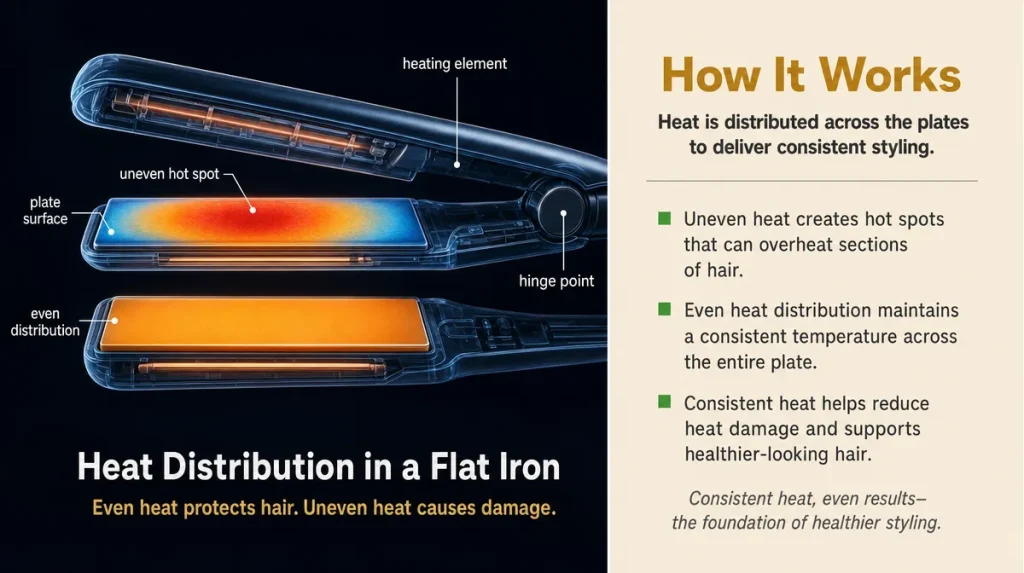
Most people assume the number on the digital display is the whole story. It isn’t. Heat is only useful if it reaches the hair evenly and holds steady while the plates are clamped shut.
Think of it like a waffle iron. A waffle iron that scorches the center and leaves the edges pale and soft isn’t a good waffle iron no matter how high its dial goes. Hair works the same way: a plate with a hot spot in the middle will straighten the center of a section while leaving the outer edges wavy, so you go back over it, and that second or third pass is where the real damage happens.
A 2019 study in the Journal of Cosmetic Science measured cuticle lifting after repeated thermal styling passes and found that damage accumulated sharply after the second pass over the same strand, even when the iron’s set temperature stayed constant. The lesson isn’t to fear heat. It’s to look for an iron that gets the job done in one pass, which almost always comes down to distribution, not degrees.
A simple in-store test: ask to see the iron’s care sheet or spec card, if the retailer has one out, and look for language about “floating plates” or “even heat mapping.” If the packaging only brags about a top temperature number and nothing about distribution, that’s a gap worth noticing.
Reading A Plate’s Material Claims Without Getting Fooled
Ceramic, tourmaline, titanium, ionic: the words on the box multiply every year, and most of them describe a coating, not the core of the plate.
A true ceramic plate is molded solid and heats evenly because the material itself conducts heat consistently. A ceramic-coated plate is usually aluminum underneath with a thin ceramic layer sprayed or baked on top. Both can perform well, but the coated version wears down faster, especially at the edges where fingers and hair tension put the most stress. Once the coating thins, the metal beneath grips hair and creates snags and uneven glide.
Tourmaline is a mineral that’s often ground into a coating and marketed for its ion-generating properties, which some manufacturers claim reduce frizz by neutralizing static charge. The evidence for this is thinner than the marketing suggests. A 2021 review in the International Journal of Trichology noted that while ionic technology may reduce static in very dry conditions, its effect on frizz caused by humidity is modest at best.
Titanium plates heat up fast and hold heat well, which suits thick or coarse hair that needs sustained heat to reshape, but titanium runs hotter overall and is less forgiving on fine or color-treated hair.
The practical test isn’t the material name. It’s whether the plate feels smooth and glassy under a fingertip, with no seams, ridges, or rough patches where the coating meets the edge. Run a finger along the plate edge in the store. If you catch on anything, that’s where your hair will catch too.
The Floating-plate Test You Can Do With Your Hands
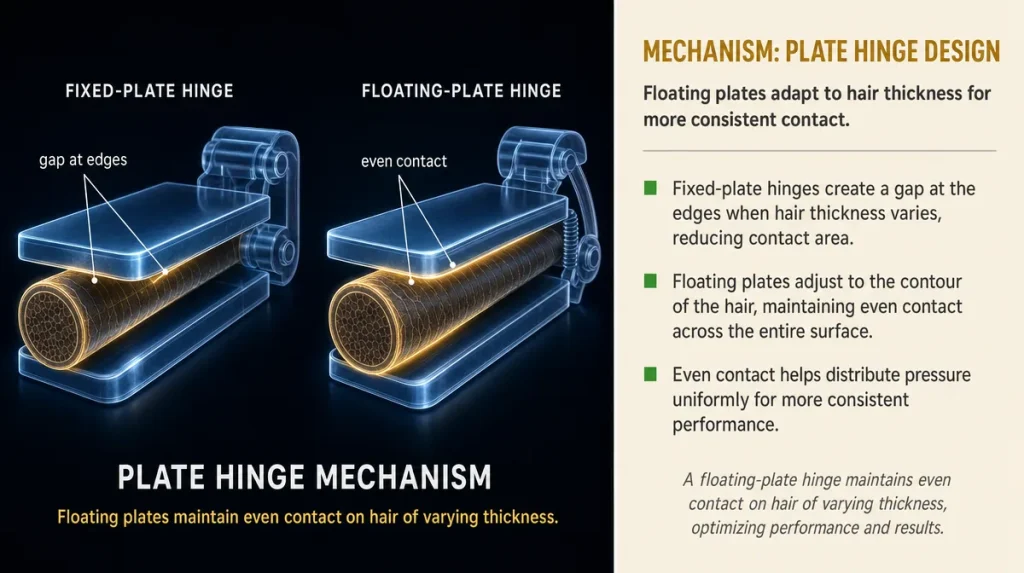
Before you check price or brand, check the hinge. Press the two plates together gently with your fingers, without the iron plugged in. A well-built iron has plates that can tilt and adjust slightly, so they close with even pressure across a section of hair that might be thicker in the middle and thinner near the ends.
A rigid, fixed-plate iron clamps evenly only if your hair section is a perfectly consistent thickness, which almost never happens in real life. Sections taper. A floating plate compensates for that taper automatically. A fixed plate does not, and you’ll feel it as a strand that slides through loose on one side while another catches and drags on the other.
Hold the iron closed and gently wiggle the plates side to side. Some give, a few millimeters of play, is a good sign. Total rigidity usually means the manufacturer prioritized a lower price point over engineering the hinge.
This single check, done in under ten seconds at a store counter, tells you more about likely performance than any number on the box.
Where Cheap Irons Actually Cut Corners
The corners that get cut on a budget iron aren’t usually in the visible plate coating. They’re in the parts you can’t see: the thermostat, the cord, and the heating element’s recovery time.
A cheaper thermostat cycles more widely, meaning the iron might read 380 degrees on the display but actually swing between 340 and 410 as it works to maintain that average. Your hair experiences the swings, not the average, which is part of why some inexpensive irons feel inconsistent from one section to the next.
Recovery time matters too. Every time you clamp the plates onto hair, the plates lose a small amount of heat, and a good heating element recovers that heat within a second or two. A weaker element takes longer, so by your fourth or fifth section, the iron is running cooler than when you started, and you compensate by turning up the dial or slowing down, both of which mean more heat exposure per strand.
Cord quality is a quieter corner-cut. A stiff, non-swivel cord doesn’t affect your hair, but it does affect how evenly you can maneuver the iron, especially at the back of your head, and awkward angles are where accidental double-passes happen most.
None of this is scandalous. It’s just where a manufacturer trims cost to hit a lower shelf price, and it shows up as inconsistency rather than outright failure.
What Realistic Results Actually Look Like
A single pass with a well-matched iron should leave hair smooth for the length of that section, with no visible line or crease where the plates gripped. If you see a faint dent line, the plates likely clamped too hard or held too long in one spot.
Humidity resistance is where expectations need the most adjustment. No flat iron, regardless of price, makes hair immune to humidity indefinitely. On a humid East Coast summer day, even a perfectly straightened style will start to soften at the hairline and ends within two to four hours for most hair textures, according to general guidance from the American Academy of Dermatology on hair care in humid climates. That’s not a product failure. It’s moisture reclaiming the hair’s natural curl pattern, and a light anti-humidity product applied before styling extends that window, it doesn’t eliminate the ceiling.
On dry winter days with indoor heating running, the opposite problem shows up: static and flyaways, especially with ionic-marketed irons that claim to reduce this. Expect improvement, not elimination.
A fair timeline to judge any iron: three to five uses across different weather conditions, not one great hair day. One good result on a dry Tuesday tells you less than a mediocre result on a humid Thursday.
Matching Plate Width To Your Actual Hair, Not The Display Model
Store displays tend to show wide plates on long, thick hair because it photographs well. That doesn’t mean a wide plate suits every head.
A narrower plate, roughly one inch or under, gives more control near the hairline, around the face, and for shorter styles, because it can navigate shorter sections without bending them at an odd angle partway through. A wider plate, closer to one and a half to two inches, covers more hair per pass, which matters for long or thick hair where narrow plates mean doubling the number of passes to finish a full head.
The mismatch problem shows up as creasing. A wide plate on short hair often can’t close fully around a short section, so it presses a crease into the middle of the strand instead of gliding the full length. A narrow plate on very thick hair means so many repeat passes that the frizz-reducing benefit gets erased by the cumulative heat exposure the extra passes cause.
A rough guide, not a rule: hair above chin length benefits from narrower plates, chin to shoulder length suits a middle width, and hair past the shoulder in thick or coarse textures generally does better with the wider option.
The Marketing Words That Mean Less Than They Sound Like
“Infrared heat” sounds advanced, and it does have a real basis: infrared heat penetrates the hair shaft slightly rather than just warming the surface, which some manufacturers say reduces the total surface temperature needed. The effect is real but modest, and it doesn’t substitute for even plate contact.
“Digital temperature control” is now standard enough that it’s not much of a differentiator. What matters is the range of that control and how tightly it holds the number you set, which the box rarely tells you directly.
“Salon professional” and similar phrasing describe a category, not a certification. There’s no governing body that verifies the phrase before it goes on a box.
“Instant heat-up” claims, usually citing a number of seconds, are one of the more verifiable claims, since you can time it yourself with a phone. If an iron promises 30-second heat-up and takes over a minute in your bathroom, that’s worth noting, though bathroom outlet voltage and cord length can shave a few seconds off any manufacturer’s lab-tested number.
None of this means marketing language is dishonest. It means the words are doing selling work, and the plate, the hinge, and the thermostat are doing the actual styling work.
A Thirty-second Self-test Before You Buy
Before checking out, run through four things, in order, whether you’re standing in a Sephora, Ulta Beauty, or Target aisle, or reading an Amazon listing with good photos.
First, look for any language about even heat distribution or floating plates, not just a top temperature number. Second, if you can touch the display model, run a finger along the plate edges feeling for seams or rough spots. Third, gently test hinge play by pressing the plates together. Fourth, match the plate width to your actual hair length using the rough guide above, not the model shown in photos.
If you’re shopping online and can’t touch anything, read the returns policy before you buy. A retailer confident in a well-engineered iron usually offers a reasonable return window, since a poorly matched purchase is common even with good research.
This isn’t a replacement for professional advice on a serious hair or scalp concern. It’s the same checklist a stylist runs through mentally before recommending a tool to a client, just slowed down so you can do it yourself.
Key Takeaways
An iron’s worth is decided by three things you can check yourself, in under a minute, before you ever plug it in.
- Even heat distribution across the full plate matters more than a high maximum temperature.
- A floating-plate hinge, tested by pressing the plates together by hand, predicts even results better than the ceramic, tourmaline, or titanium label on the box.
- Plate width should match your hair’s actual length and texture, not the model shown in the display photo.
- Expect three to five uses across different weather conditions before judging an iron fairly, since humidity and dry indoor heat both change the outcome regardless of the tool.
- Marketing phrases like infrared heat, digital control, and salon professional describe features, not guarantees, and none of them substitute for a hands-on check of the plate and hinge.
This article is for general information and does not replace advice from a licensed stylist or dermatologist.
Individual results vary based on hair type, texture, and styling habits.